

Table of Contents
Aluminum tube bend radius is not a single catalog number that applies to every tube. A workable radius depends on alloy, temper, product form, outside diameter, wall thickness, seam condition, bend angle, tooling, lubrication, surface finish, required ovality, wall thinning, and dimensional tolerance.
Engineering and purchasing teams should define aluminum tube bend radius at the tube centerline or clearly name another reference, then qualify the production process. A large radius is generally less demanding than a tight one, but final acceptance must be based on the actual component, drawing, material certificate, tooling, and inspection plan.
Define the Radius
State whether the drawing dimension is centerline radius, inside radius, or outside radius. Centerline radius is commonly used for bent tube geometry, but assumptions create tooling and inspection errors. Also define bend angle, tangent points, leg lengths, orientation, clocking, and the datum scheme for the finished part.
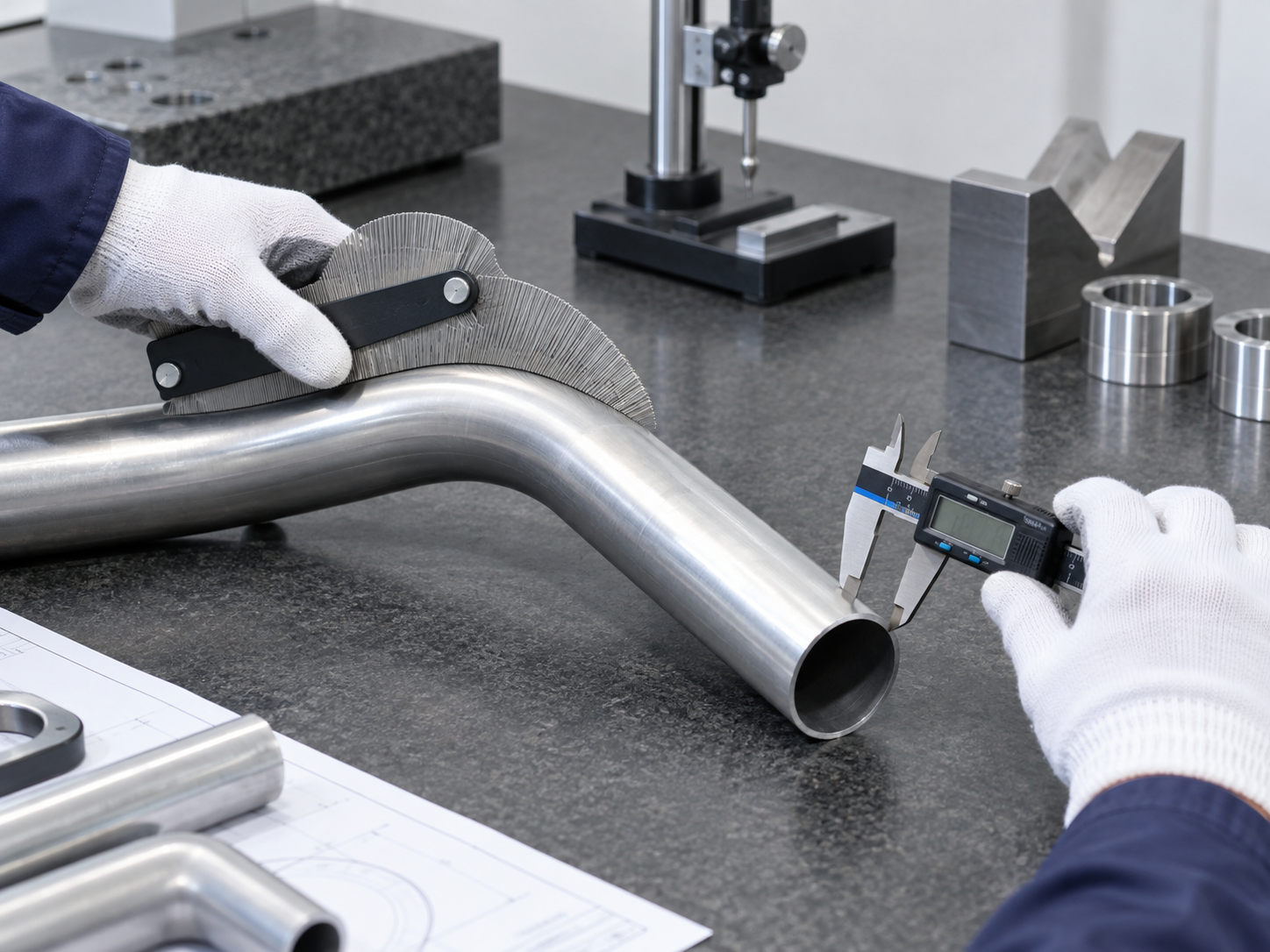
An aluminum tube bend radius requirement should include dimensional tolerance and measurement method. A flexible contour gauge, template, coordinate measurement, fixture, or dedicated gauge may serve different production needs. Agree on where the arc begins and ends, especially when transition zones are influenced by clamp and pressure dies.
Select Alloy and Temper
Alloy and temper determine the supplied strength, ductility, and springback response. Product form also matters: extruded, drawn, seamless, and porthole tube may have different dimensional, surface, and structural considerations. Use the material standard and drawing to identify the exact tube rather than ordering only by diameter.
ASTM B491/B491M covers specified extruded round tubes for defined general-purpose applications and points purchasers toward other standards for other tube forms. The aluminum tube bend radius still requires a separate forming qualification because a supply standard does not certify a finished bend.
Evaluate Tube Geometry
Outside diameter and wall thickness should be reviewed together. A high diameter-to-wall relationship tends to increase sensitivity to flattening, wrinkling, and wall thinning, while a tighter radius increases forming severity. These relationships guide tooling selection but do not replace a production trial or approved design analysis.
For aluminum tube bend radius planning, use minimum ordered wall where structural or pressure performance depends on the thinnest location after bending. Include outside-diameter tolerance, wall tolerance, initial ovality, straightness, cut length, and end condition so incoming variation is represented in qualification material.
Choose Process and Tooling
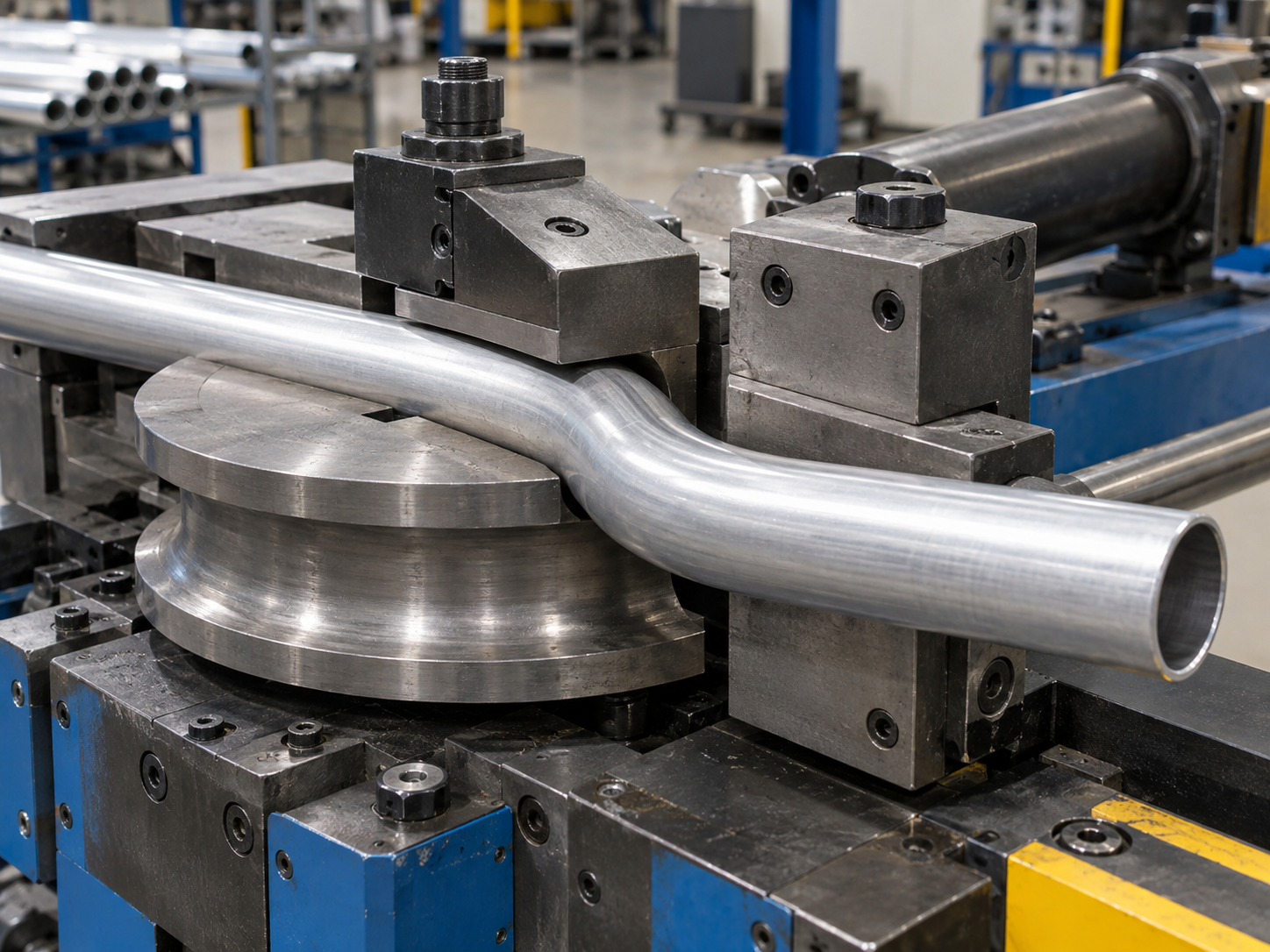
Rotary draw bending, compression bending, roll bending, stretch bending, and other methods support different radii, angles, quantities, and quality levels. Tight, thin-wall work may need a mandrel, wiper die, pressure die assistance, suitable clamp length, controlled lubrication, and carefully matched bend-die groove.
An aluminum tube bend radius should therefore be reviewed with the intended machine and complete tool stack. Tool wear, grip, alignment, lubrication, feed, rotation, and tube cleanliness affect repeatability. A successful hand bend or prototype on different tooling does not establish production capability.
Allow for Springback
Aluminum commonly recovers elastically after the forming load is removed. The resulting springback affects final angle and radius and varies with alloy, temper, geometry, process, and lot condition. The machine program may intentionally overbend, but the drawing should specify the finished geometry rather than the compensation setting.
Qualify aluminum tube bend radius and angle after unloading and at the inspection condition used for acceptance. When multiple bends share one part, examine accumulated length, rotation, and tangent errors. Record program revision and tooling identity so later adjustments do not silently change a validated component.
Control Bend Defects
Typical bend concerns include outside-wall thinning, inside-wall thickening or wrinkling, cross-section ovality, flattening, buckling, surface scoring, die marks, cracking, twisting, and tangent distortion. Cosmetic acceptance and structural acceptance are different and both should be defined where relevant.
ISO 6363-6:2022 addresses form and dimensional tolerances for covered drawn round tubes. It does not create a universal aluminum tube bend radius. Buyers must specify post-bend limits and consider how thinning, ovality, and finish affect the actual application.
| Design input | Why it matters | Qualification evidence |
|---|---|---|
| Radius reference | Prevents centerline and inside-radius confusion | Controlled drawing and gauge method |
| OD and wall | Influence thinning, wrinkling, and ovality | Incoming and post-bend measurements |
| Alloy and temper | Affect ductility and springback | Material certificate and trial lot |
| Tooling package | Controls support, grip, and surface contact | Tool IDs and approved setup |
| Service requirement | Sets structural and cosmetic limits | Engineering acceptance criteria |
Qualify and Inspect
Use representative production material for bend qualification. Inspect incoming tube identity and dimensions, then measure final radius, angle, tangent lengths, leg positions, rotation, outside dimensions, ovality, minimum wall where required, cracks, wrinkles, and surface condition. Destructive sectioning or specialized nondestructive methods may be needed for critical wall verification.
Connect the article to the broader aluminum product portfolio and review the 6061 temper and bendability guide for related material-selection principles. Rod guidance does not replace tube-specific qualification, but alloy and temper discipline remains essential.
- Define the aluminum tube bend radius as centerline, inside, or outside radius.
- Specify alloy, temper, product form, OD, wall, and tolerances.
- Qualify production tooling, lubrication, and program revision.
- Set aluminum tube bend radius limits for angle, ovality, thinning, wrinkles, cracks, and marks.
- Inspect representative parts and difficult bend locations.
- Maintain material and process traceability.
- Approve every aluminum tube bend radius or material change in writing.
Write the Tube RFQ
The RFQ should state standard and edition, alloy, temper, tube form, outside diameter, wall thickness, tolerances, cut length, seam orientation if relevant, finish, protected zones, bend reference, radius, angle, tangent and leg dimensions, quantity, process restrictions, post-bend limits, inspection, reports, marking, and packaging.
A complete aluminum tube bend radius specification also identifies the service: structural load, pressure, fluid cleanliness, fatigue, corrosion exposure, welding, coating, or visible architecture. Require written approval before changing alloy, temper, tube source, wall, tooling, lubricant, heat treatment, or qualified process.
Frequently Asked Questions
What is bend radius on aluminum tube?
Aluminum tube bend radius is the radius of the formed arc, commonly referenced at the tube centerline. Drawings must state the reference because inside, centerline, and outside radii differ.
What is the minimum bend radius for aluminum tube?
There is no universal aluminum tube bend radius minimum. It depends on alloy, temper, tube form, outside diameter, wall thickness, angle, tooling, allowed defects, and service.
How do you bend aluminum tube without kinking it?
Use a qualified aluminum tube bend radius, suitable material, matched tooling, adequate support such as a mandrel when required, controlled lubrication, alignment, and a stable machine process.
Does aluminum tube get thinner when bent?
The outside wall normally tends to thin while the inside wall can thicken or wrinkle. Verify aluminum tube bend radius results by measuring the finished part.
How much does aluminum tube spring back after bending?
Aluminum tube bend radius springback varies with alloy, temper, diameter, wall, angle, tooling, and process. Establish compensation through representative trials and inspect the unloaded part.
Request a Bending Review
Send Huanhai Zhongke the tube standard, alloy, temper, form, outside diameter, wall, drawing, aluminum tube bend radius, angle, service, defect limits, inspection, and packaging requirements for a material review.
 English
  Korean
  Arabic
  Vietnamese