

Table of Contents
The 5083 vs 5086 aluminum plate decision applies mainly to welded structures and marine or corrosive environments where alloy, temper, thickness, fabrication, and governing approval must work together. Neither designation should be selected from a generic claim that one grade is always better.
This 5083 vs 5086 aluminum plate guide helps engineers and buyers compare the two 5xxx-series wrought alloys without inventing universal property values. Final selection should use the project standard, approved design data, exact temper, certified test results, and qualified welding procedures.
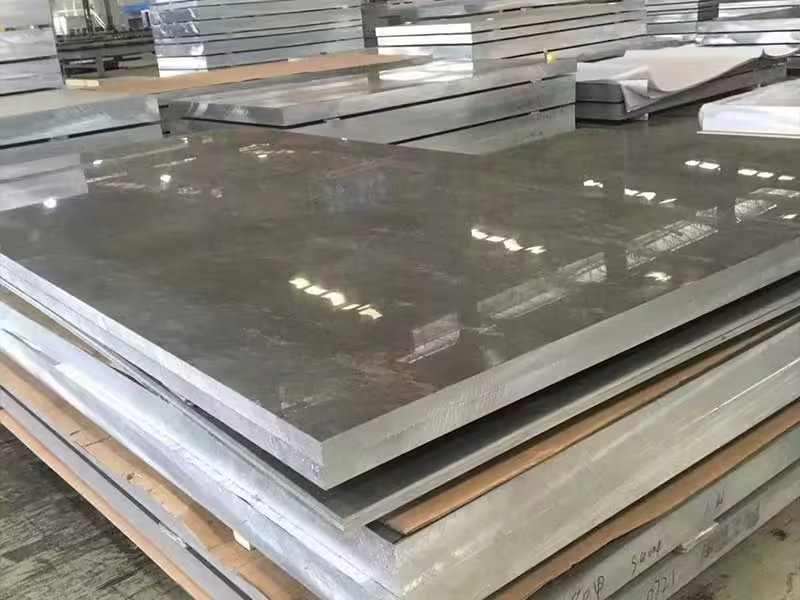
Start With Design Approval
Begin a 5083 vs 5086 aluminum plate review with the vessel, tank, platform, enclosure, deck, or fabricated component. Define loads, fatigue, impact, forming, weld configuration, temperature, immersion, splash, atmosphere, chemicals, and inspection authority.
Classification rules, drawings, codes, and owner specifications may restrict alloys and tempers. A supplier cannot replace that approval with a commercial recommendation. Identify the controlling document and resolve every 5083 vs 5086 aluminum plate substitution through the responsible engineer. Record whether approval applies to parent plate, welded structure, or both.
Compare Alloy Composition
Both alloys are aluminum-magnesium 5xxx-series products, but their registered chemical-composition limits differ. Those limits influence available property ranges and fabrication behavior. Use the Aluminum Association international alloy designations rather than unverified chemistry tables.
The 5083 vs 5086 aluminum plate comparison should not be reduced to one element or nominal percentage. Certificates must show conformance to the ordered specification, and engineering decisions should use the complete alloy-temper-property definition.
Compare Strength and Forming
5083 is commonly evaluated when higher strength within this comparison is important, while 5086 is also used for weldable marine fabrication. Exact tensile and yield requirements depend on temper, thickness, standard, and product form. A 5083 vs 5086 aluminum plate design must use specified minimums or approved design values, not an isolated typical value.
Formability depends on temper, bend radius, rolling direction, thickness, tooling, and edge condition. A 5083 vs 5086 aluminum plate forming trial should reproduce the ordered condition; results from soft sheet or another thickness do not qualify a production plate.
Select the Required Temper
Temper suffixes identify the supplied condition and can include strain-hardened, stabilized, or marine-service conditions. The same alloy name in a different temper may have different property, corrosion, and fabrication requirements.
Never write a 5083 vs 5086 aluminum plate order without temper. For marine-service tempers, confirm the governing corrosion-testing and production requirements. Do not substitute a general temper merely because its room-temperature strength appears similar.

Review Welding
Both alloys can be welded using approved processes, joint design, preparation, filler selection, heat input, sequence, and inspection. Welding changes local properties and can create distortion. The design must use appropriate welded-joint values rather than unwelded parent-plate values.
A 5083 vs 5086 aluminum plate welding review should cover oxide removal, cleanliness, consumables, qualification, joint access, distortion control, nondestructive examination, repair limits, and compatibility with later coating or service.
Control Marine Corrosion
ASTM B928/B928M covers high-magnesium aluminum-alloy sheet and plate for marine service and similar environments, including additional corrosion-related requirements for covered alloy-temper products. Use the edition required by the contract.
The 5083 vs 5086 aluminum plate choice does not eliminate galvanic corrosion, crevices, trapped water, coating damage, unsuitable fasteners, or poor drainage. The table summarizes decision controls, not service-life guarantees.
| Decision factor | 5083 screening position | 5086 screening position |
|---|---|---|
| Strength demand | Often evaluated for higher-strength requirements | Verify exact temper properties |
| Marine fabrication | Widely specified in approved conditions | Widely specified in approved conditions |
| Forming | Temper and radius control required | Temper and radius control required |
| Welding | Use qualified joint data | Use qualified joint data |
| Corrosion assurance | Apply governing marine standard | Apply governing marine standard |
Verify Certification
Receiving inspection should match plate markings, packing lists, certificates, alloy, temper, dimensions, flatness, surface, and ordered tests. Maintain heat or lot traceability through cutting and fabrication where the project requires it.
Review the aluminum plate supply range and the 5083 marine aluminum plate guide. A documented 5083 vs 5086 aluminum plate review should connect certified material to the approved component drawing.
- Identify the controlling design or classification document.
- Compare exact alloy, temper, thickness, and property limits.
- Review forming and welding on production material.
- Specify corrosion-testing requirements for marine service.
- Control galvanic contact, drainage, coatings, and fasteners.
- Maintain lot traceability through fabrication.
- Document the 5083 vs 5086 aluminum plate approval decision.
Prepare the RFQ
State standard and edition, alloy, temper, thickness, width, length, dimensional tolerances, flatness, surface, testing, certification, marking, traceability, packing, destination, and any class or owner approval. Attach welding and forming requirements when they affect selection.
Require written disclosure of deviations. A complete 5083 vs 5086 aluminum plate RFQ lets suppliers quote the same technical scope and prevents a change in temper, inspection, corrosion testing, or certification from being hidden inside a nominal alloy match. Verify document language before release to production.
Frequently Asked Questions
Which is stronger, 5083 or 5086 aluminum plate?
5083 is commonly evaluated for higher strength, but the valid comparison must use the exact temper, thickness, specification, and certified property limits. This makes a 5083 vs 5086 aluminum plate review project-specific.
Are both 5083 and 5086 considered marine aluminum?
Both are used in marine applications in approved alloy-temper conditions. Suitability depends on the governing standard, component design, exposure, fabrication, and required corrosion testing.
Can 5083 and 5086 aluminum plate be welded?
Yes, with qualified procedures, compatible filler selection, controlled preparation and heat input, and appropriate design values for the welded condition.
Can 5083 and 5086 plate be substituted directly?
No. Engineering must review strength, temper, thickness, forming, welding, corrosion requirements, approvals, availability, and certification before substitution.
Which standard applies to marine 5083 and 5086 plate?
ASTM B928/B928M is one recognized specification for covered high-magnesium aluminum-alloy sheet and plate intended for marine service and similar environments.
Request a Marine Plate Review
Send Huanhai Zhongke the drawing, governing standard, service environment, alloy options, temper, thickness, welding, forming, testing, certification, and approval requirements for a 5083 vs 5086 aluminum plate supply review.
 English
  Korean
  Arabic
  Vietnamese