

Table of Contents
Seamless steel pipe heat treatment influences strength, hardness, toughness, dimensional stability, machinability, and suitability for later fabrication. It is not a universal finishing step with one temperature or one result. The required condition depends on the steel grade, product specification, pipe dimensions, manufacturing route, and intended service.
For buyers, the practical issue is traceability. A purchase order should identify the governing standard and required delivery condition, while the inspection documents should show that the supplied pipe meets the specified chemical, mechanical, dimensional, and testing requirements. This guide explains how to review seamless steel pipe heat treatment without replacing the project engineer’s material selection or the requirements of the applicable code.
Why Heat Treatment Matters
Pipe leaving a hot-forming or cold-drawing operation can retain a microstructure, hardness level, and residual-stress pattern that are not appropriate for every application. Seamless steel pipe heat treatment uses controlled heating, holding, and cooling to establish the condition required by a product standard or agreed specification. The result must be evaluated through documented properties, not through appearance alone.
Heat treatment can support several objectives: refining or restoring microstructure, obtaining a required strength and toughness balance, reducing excessive hardness, improving machinability, or preparing alloy steel for high-temperature service. These objectives can conflict. A condition that maximizes strength may not provide the forming response or toughness needed elsewhere, which is why seamless steel pipe heat treatment must be tied to grade and service.
Start With the Product Standard
The product standard is the controlling reference for seamless steel pipe heat treatment. It defines the grades, permitted manufacturing routes, required properties, tests, dimensions, marking, and delivery provisions. Buyers should state the full designation and required edition when the contract demands a particular revision. A broad request for heat-treated seamless pipe is not enough to define seamless steel pipe heat treatment.
For example, the current ASTM A106/A106M specification page describes seamless carbon steel pipe for high-temperature service and lists mechanical and pressure-related tests. Alloy-steel applications may instead be governed by another specification; the ASTM A335/A335M specification page covers seamless ferritic alloy-steel pipe and includes grade-dependent property and examination requirements. These examples show why the designation must precede the process instruction.
Do not transfer a seamless steel pipe heat treatment requirement from one grade or standard to another based only on a similar operating temperature. Carbon steel, low-alloy steel, and stainless grades respond differently to thermal cycles. The engineer should approve the material specification, and the supplier should manufacture and document the pipe against that approved basis.
Understand Common Delivery Conditions
In seamless steel pipe heat treatment, terms such as as-rolled, annealed, normalized, normalized and tempered, quenched and tempered, or solution treated describe different conditions, but their exact requirements come from the relevant standard. Seamless steel pipe heat treatment terminology should therefore be copied accurately from the approved material specification rather than simplified into a generic note.
Annealing is generally associated with heating and controlled cooling to modify microstructure, soften material, or relieve effects of prior working, depending on alloy and procedure. Normalizing typically uses heating above a transformation range followed by cooling in air or a controlled environment. Quenching and tempering combines rapid cooling with a subsequent tempering stage to develop a specified property balance. Solution treatment applies to appropriate alloy systems under their governing requirements.
These descriptions are intentionally general. A buyer should not insert an assumed seamless steel pipe heat treatment temperature into the order unless it comes from the applicable standard, approved engineering specification, or qualified procedure. Furnace temperature alone does not prove conformity; holding time, pipe section, cooling method, furnace uniformity, and test results also matter.
Connect Process to Properties
The acceptance target for seamless steel pipe heat treatment is the resulting material condition. Depending on the specification, evidence may include tensile strength, yield strength, elongation, hardness, impact properties, grain structure, or other grade-specific requirements. Not every property applies to every pipe, so the inspection plan should follow the order rather than a generic checklist copied from another project.
Hardness is useful for detecting an unexpected condition, but a single hardness value does not fully describe toughness, microstructure, or service performance. Likewise, a tensile certificate does not replace any required impact test, heat-treatment record, hydrostatic test, or nondestructive examination. Seamless steel pipe heat treatment should be assessed as one part of the full material compliance package.
Downstream operations must also be considered. Cold bending, hot forming, extensive machining, welding, or post-weld heat treatment can change the delivered condition or introduce new requirements. When a fabricator will apply another thermal cycle, the material engineer should review how it interacts with the original seamless steel pipe heat treatment and the final code requirements.
Account for the Manufacturing Route
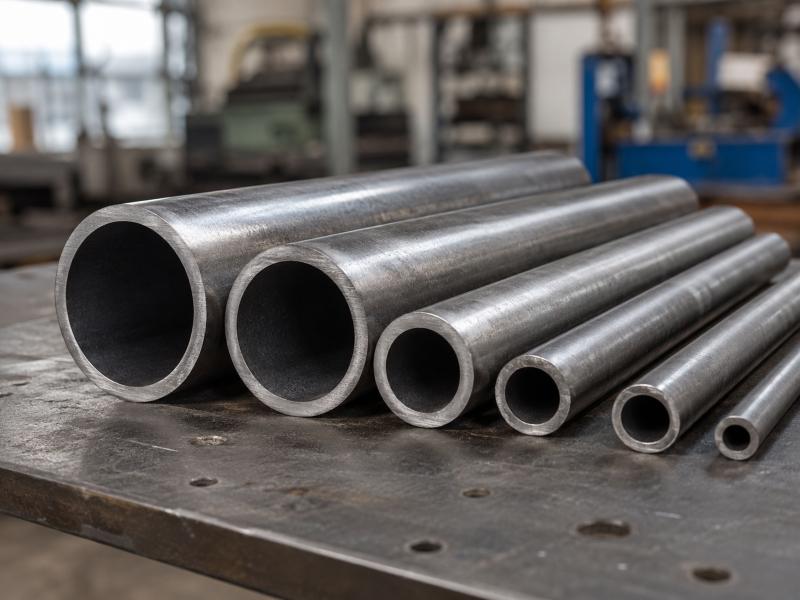
Seamless steel pipe heat treatment for hot-finished and cold-drawn pipes must account for their different metallurgical and dimensional conditions. Cold work can increase strength and hardness while reducing ductility, and a subsequent thermal cycle may be required by the product standard. Hot finishing also does not automatically establish every specified property. Seamless steel pipe heat treatment must be reviewed together with the stated manufacturing route.
Wall thickness affects how quickly a pipe section heats and cools. Long lengths, thick walls, and mixed furnace loads can make temperature uniformity and handling more demanding. These are production-control issues for the manufacturer, but the buyer should define any required records and verify that test specimens represent the supplied lot under the applicable sampling rules.
Dimensional inspection remains necessary after seamless steel pipe heat treatment because heating, cooling, straightening, and handling can affect straightness, ovality, length, and surface condition. The order should state outside diameter, wall thickness, length, end preparation, straightness, and any tighter project tolerances instead of assuming heat treatment guarantees geometry.
Verify Testing and Certificates
For seamless steel pipe heat treatment, a material test report should identify the manufacturer, specification, grade, size, heat or lot reference, chemical analysis, mechanical results, and other required tests. Where the standard or purchase order requires seamless steel pipe heat treatment information, the certificate should identify the delivered condition clearly enough to link it to the supplied material.
Receiving teams should match the pipe marking and package labels to the certificate before relying on the results. Review heat numbers, grade, standard, dimensions, quantity, and test records. If the order requires additional hardness mapping, impact testing, nondestructive examination, or witnessed inspection, those requirements must be agreed before production and included in the inspection and test plan.
Buyers can compare available seamless steel pipe product forms with the project’s size and processing needs. The related seamless steel pipe grade selection guide helps connect grade choice to service before the seamless steel pipe heat treatment condition is finalized.
Compare Purchasing Scenarios
The table summarizes common purchasing situations. It does not assign a treatment to a grade; it shows which questions should be resolved before seamless steel pipe heat treatment is placed on the order.
| Purchasing situation | Main technical risk | Required buyer action |
|---|---|---|
| Standard-grade pipe for defined service | Wrong standard, grade, or delivery condition | State the complete product specification, grade, size, and required condition |
| Cold-drawn precision requirement | Property and dimensional changes after processing | Confirm manufacturing route, final treatment, straightening, tolerances, and test basis |
| Alloy pipe for elevated temperature | Inappropriate thermal condition or incomplete testing | Use the approved alloy specification and require grade-specific records |
| Pipe requiring later forming or welding | Delivered properties altered during fabrication | Have engineering review forming, welding, and any later thermal cycle |
| Critical project with supplementary tests | Tests omitted because they were not ordered | List supplementary examinations, sampling, witnessing, and documentation explicitly |
The safest procurement route is specification-driven. A supplier may be capable of several heat-treatment cycles, but capability does not authorize a substitution. Any proposed change to grade, manufacturing route, seamless steel pipe heat treatment condition, testing, or dimensional tolerance should receive written technical approval before production.
Prepare the Purchase Order
A complete seamless steel pipe heat treatment request for quotation gives every supplier the same technical baseline. Use the following checklist to prevent commercial quotations from being based on different assumptions about seamless steel pipe heat treatment.
- Identify the application, design code, product specification, edition, and grade.
- State outside diameter, wall thickness, length, quantity, ends, and dimensional tolerances.
- Name the manufacturing route and required delivery or heat-treated condition.
- List required tensile, hardness, impact, hydrostatic, or nondestructive tests as applicable.
- Define certificate type, heat and lot traceability, inspection reports, and witnessing points.
- Describe surface condition, corrosion protection, end caps, bundling, labels, and transport requirements.
- Require written disclosure and approval of every technical deviation.
Avoid acceptance phrases such as normal heat treatment, standard quality, or suitable for high temperature without a controlling specification. They are difficult to verify and may mean different things to different suppliers. Seamless steel pipe heat treatment should be expressed through an approved condition and measurable acceptance evidence.
Frequently Asked Questions
Does every seamless steel pipe require heat treatment?
No. The requirement depends on the product specification, grade, manufacturing route, dimensions, and service. Use the governing standard and approved engineering documents.
What heat treatments are used for seamless steel pipe?
Depending on the steel and specification, conditions may include annealed, normalized, normalized and tempered, quenched and tempered, or solution treated. Exact requirements are grade-specific.
How is heat treatment verified on a certificate?
Match the certificate to pipe markings and review the stated delivery condition, specification, grade, heat or lot identity, mechanical results, and any required treatment records.
Is hardness testing enough to confirm heat treatment?
Not by itself. Hardness can support verification, but conformity may also require tensile, impact, microstructural, pressure, or nondestructive tests under the applicable specification.
Can welding change the delivered heat-treated condition?
Yes. Welding and later thermal cycles can alter the local microstructure and properties. The qualified welding procedure and applicable code must address the final fabricated condition.
Request a Technical Review
Send Huanhai Zhongke the product standard, grade, dimensions, required condition, fabrication route, service environment, testing, and documentation needs for a technical review. A complete specification allows seamless steel pipe heat treatment requirements and exceptions to be resolved before quotation and production.
 English
  Korean
  Arabic
  Vietnamese