

Table of Contents
Aluminum coil weight calculation helps buyers check lifting capacity, transport planning, decoiler limits, inventory, expected strip length, and the plausibility of a supplier quotation. The result is an engineering estimate unless the coil is weighed on a suitable calibrated scale.
A useful aluminum coil weight calculation must define the measurement units, outside diameter, inside diameter, coil width, and alloy density. It should also distinguish gross shipping mass from net metal mass and record whether the core, wrapping, bands, and pallet are included.
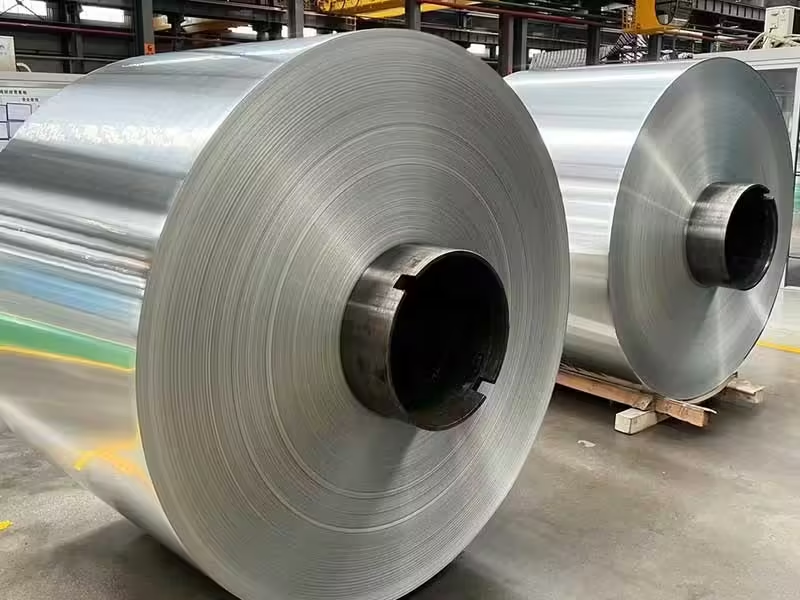
Why Coil Weight Matters
Start an aluminum coil weight calculation with the decision it needs to support. Crane and mandrel checks require a conservative maximum coil mass, production planning may need estimated strip length, and receiving inspection needs a repeatable comparison between measured and documented values.
Do not use one aluminum coil weight calculation result for every purpose. A coil can be within the purchase-order mass range but exceed a particular decoiler, turnstile, floor, or lifting-device limit. Equipment ratings, approved lifting procedures, and site safety controls remain controlling.
Use the Annulus Formula
Viewed from the side, a wound coil is an annulus: a circular area with the core opening removed. For OD, ID, and width in millimeters and density in kilograms per cubic millimeter, aluminum coil weight calculation follows mass = pi divided by four, multiplied by OD squared minus ID squared, multiplied by width and density.
For density expressed in grams per cubic centimeter, a convenient metric form is kilograms = pi/4 x (OD squared – ID squared) x width x density x 10^-6. Keep all dimensions in millimeters. Show the units and rounding in the worksheet so another person can reproduce the result.
Measure OD, ID, and Width
Measure OD across the widest points without including loose wrapping or banding. Measure the ID at the metal bore or defined core interface, and measure the actual metal width. An aluminum coil weight calculation based on nominal catalog dimensions may differ from the delivered coil because OD, width, winding tightness, and edge build vary.
For a repeatable aluminum coil weight calculation, take more than one OD reading if the coil is out of round or telescoped. Do not force a tape or gauge into an unsafe position. Record the measurement method, instrument, coil identity, and whether the coil remained packaged.
Select a Defensible Density
Density is alloy dependent and should come from the approved material data used by the project. A general aluminum value may be adequate for an early estimate, but it should not be presented as exact for every alloy. The Aluminum Association standards resources identify recognized alloy and temper systems.
The aluminum coil weight calculation from OD and ID estimates the metal volume in the annulus. Real coils can contain small air gaps, interleaf, coating, lubricant, protective film, a core, or joints. State what the estimate includes and use a scale when contractual net mass is required.
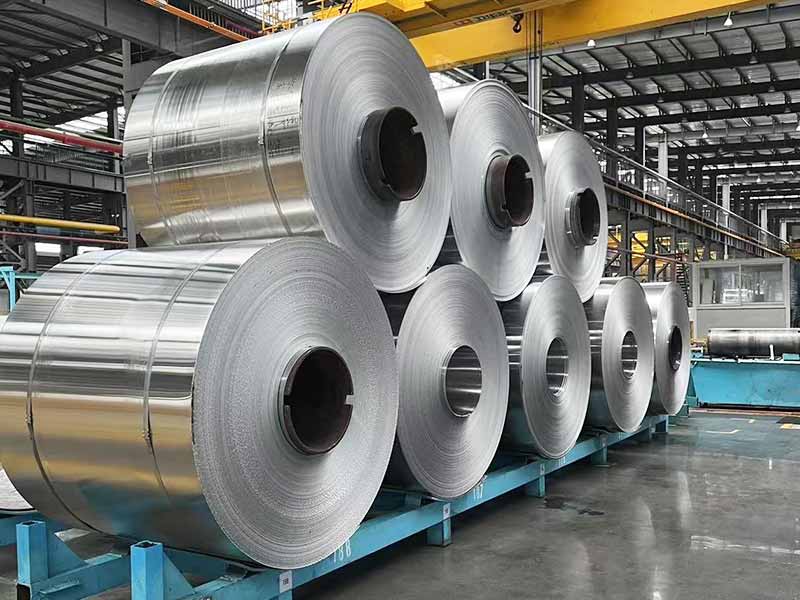
Estimate Strip Length
If known mass, thickness, width, and density are available, estimated strip length equals mass divided by thickness, width, and density after consistent unit conversion. This second aluminum coil weight calculation is useful for line scheduling, yield checks, and comparing coil tickets with production consumption.
Thickness tolerance changes estimated length because a fixed mass contains less length when the strip is thicker. Coating and film can also affect gross mass. Use the ordered or measured metal thickness according to the purpose of the estimate, and document that choice.
Understand Calculation Error
The largest errors usually come from inconsistent units, diameter readings that include packaging, wrong density, confusing radius with diameter, or mixing net and gross mass. Squared diameters make OD and ID errors important. Aluminum coil weight calculation spreadsheets should protect unit cells and identify every input.
Verify the aluminum coil weight calculation independently by comparing it with the scale ticket, calculating expected length from mass, or checking weight per unit length. Investigate differences before assuming shortage; measurement method, packaging, coil shape, thickness, and density may explain the variance.
| Input or check | Why it matters | Common mistake |
|---|---|---|
| Outside diameter | Defines the outer annulus boundary | Including wrapping or using radius |
| Inside diameter | Removes the core opening from metal volume | Using core OD without defining the interface |
| Coil width | Converts annulus area to volume | Using package width |
| Alloy density | Converts volume to estimated mass | Applying one value to every alloy |
| Scale ticket | Confirms actual gross or net mass | Not defining tare and packaging |
Verify Handling and Equipment
Use the calculated result to screen coil car, crane, C-hook, sling, pallet, rack, floor, and decoiler limits. Never treat aluminum coil weight calculation as a lifting plan. Only trained personnel using approved equipment and site procedures should move or load coils.
The comparison table separates useful calculation inputs from operational controls. Review the aluminum coil product range and the aluminum coil packaging guide when matching mass, dimensions, and export protection.
- Record OD, ID, width, units, and measurement method.
- Use approved alloy density and show all conversions.
- Separate net metal mass from pallet, core, bands, film, and wrapping.
- Compare the estimate with the coil ticket or calibrated scale.
- Check every handling and processing equipment limit independently.
- Place maximum coil mass and OD directly on the RFQ.
- Keep the aluminum coil weight calculation with the receiving record.
Write the RFQ
A complete aluminum coil weight calculation RFQ states alloy, temper, standard, thickness, width, maximum and target coil mass, ID, maximum OD, winding direction, surface, coating, film, edge, joints, certificate, labels, and packaging. Include the equipment limits that drive the coil requirement.
Use ASTM B209/B209M or the contractually required material specification for product requirements. Aluminum coil weight calculation supports the purchase specification, but it does not replace agreed dimensional tolerances, inspection, certificates, or actual weighing.
Frequently Asked Questions
What is the formula for aluminum coil weight calculation?
Treat the wound metal as an annulus. Multiply pi/4 by OD squared minus ID squared, then by coil width and the selected aluminum-alloy density, using consistent units.
Does thickness affect aluminum coil weight calculation?
Thickness is not required when weight is calculated from OD, ID, width, and density. It is required when calculating mass from strip length or estimating strip length from mass.
What density should be used for an aluminum coil?
Use the density for the ordered alloy from an approved technical source. A generic aluminum density is suitable only for preliminary estimates and should not be represented as exact for every alloy.
Why does calculated coil weight differ from the scale ticket?
Possible causes include measurement error, coil shape, air gaps, thickness variation, alloy density, coating, film, interleaf, core, bands, wrapping, pallet, and confusion between net and gross mass.
How can coil length be estimated from weight?
Divide net metal mass by thickness, width, and alloy density after converting all quantities into a consistent unit system. Treat the result as an estimate when dimensions vary.
Request a Coil Review
Send Huanhai Zhongke the alloy, temper, thickness, width, ID, maximum OD, target mass, winding, surface, equipment limits, and packaging requirements for an aluminum coil weight calculation and supply review.
 English
  Korean
  Arabic
  Vietnamese