

Aluminum plate specifications directly affect machining performance, structural strength, corrosion resistance, surface quality, and overall procurement costs. For industrial buyers, choosing aluminum plate requires more than confirming thickness and quantity.
Alloy grade, temper, dimensions, tolerance, flatness, surface finish, applicable standards, and processing requirements should all match the intended application. This guide explains the most important factors buyers should evaluate when sourcing aluminum plate for manufacturing, fabrication, construction, machinery, and other industrial projects.
Table of Contents
What Specifications Should You Provide When Buying Aluminum Plate?
A complete aluminum plate inquiry should provide enough technical information for the supplier to identify the correct material and production requirements.
Simply asking for “aluminum plate” can result in multiple possible alloys, tempers, thicknesses, and surface conditions. These materials may look similar but perform very differently during machining, welding, bending, or surface treatment.
For most industrial orders, buyers should consider alloy, temper, thickness, width, length, tolerance, surface condition, quantity, applicable standard, and packaging.

| Specification | Why It Matters |
|---|---|
| Alloy | Determines strength, corrosion resistance, machinability and formability |
| Temper | Determines hardness and mechanical properties |
| Thickness | Affects weight, rigidity and machining allowance |
| Width and Length | Influences fabrication and material utilization |
| Tolerance | Controls dimensional accuracy |
| Flatness | Important for machining and assembly |
| Surface Finish | Affects appearance and downstream treatment |
| Standard | Defines material and quality requirements |
| Quantity | Influences production and logistics |
| Packaging | Protects material during transportation |
For buyers who are still comparing different grades, the existing aluminum alloy selection guide can be used as a starting point before finalizing the material specification.
How Does Aluminum Alloy Affect Plate Selection?
The alloy is one of the most important aluminum plate specifications because it determines the material’s basic performance.
Different aluminum alloys are designed for different combinations of strength, corrosion resistance, machinability, weldability, and formability.
| Alloy | Main Characteristics | Typical Applications |
|---|---|---|
| 1060 | High purity and conductivity | Electrical and general fabrication |
| 1100 | Good formability and corrosion resistance | Heat exchangers and general fabrication |
| 3003 | Good formability and moderate strength | Panels, HVAC and construction |
| 5052 | Excellent corrosion resistance | Marine and outdoor applications |
| 5083 | High strength and corrosion resistance | Marine and heavy-duty structures |
| 6061 | Balanced strength and machinability | CNC parts and machinery |
| 6082 | Good structural strength | Engineering components |
| 7075 | Very high strength | Aerospace and high-load components |
A higher-strength alloy is not automatically a better choice.
For example, 7075 may be suitable for high-load precision components, but it can be unnecessary for a general equipment panel. Similarly, 5052 may be a better option than 6061 when corrosion resistance and forming performance are more important than machining efficiency.
The correct alloy should therefore be selected according to the final application rather than simply choosing the strongest available material.
What Does Aluminum Temper Mean?
Aluminum alloy and aluminum temper describe two different characteristics of the material.
The alloy identifies its chemical composition, while the temper indicates the condition created through heat treatment, cold working, aging, or other processing.
This distinction becomes particularly important when ordering aluminum plate for CNC machining or structural applications.
Why Is T6 Aluminum Commonly Used?
T6 indicates a heat-treated and artificially aged condition. 6061-T6 is widely used in industrial manufacturing because it combines good strength with excellent machinability.
However, T6 is not appropriate for every application.
If a component requires extensive bending, a softer temper may provide better formability. If high mechanical strength is required, a heat-treated temper may be more appropriate.
Therefore, a specification such as 6061-T6 aluminum plate provides much more useful information than simply requesting 6061 aluminum.
Which Standards Apply to Aluminum Plate?
International standards provide a common technical framework for material composition, mechanical properties, dimensions, tolerances, testing, and quality requirements.
Depending on the destination market, buyers may encounter ASTM, EN, ISO, AMS, and other national or industry-specific standards.
For North American projects, buyers can check the relevant material requirements through ASTM International before placing an order. For international projects, the applicable standard should be confirmed with the engineering team or end customer.
Why Are Standards Important for International Buyers?
Standards reduce ambiguity between suppliers and customers.
For example, a buyer requesting “high-strength aluminum plate” has not provided enough information for consistent production. But specifying the alloy, temper, dimensions, and applicable standard creates a much clearer technical requirement.
This becomes especially important when aluminum plate is purchased internationally.
A supplier in China, Europe, or another manufacturing region may otherwise interpret the same general product description differently.
How Does Thickness Affect Aluminum Plate Performance?
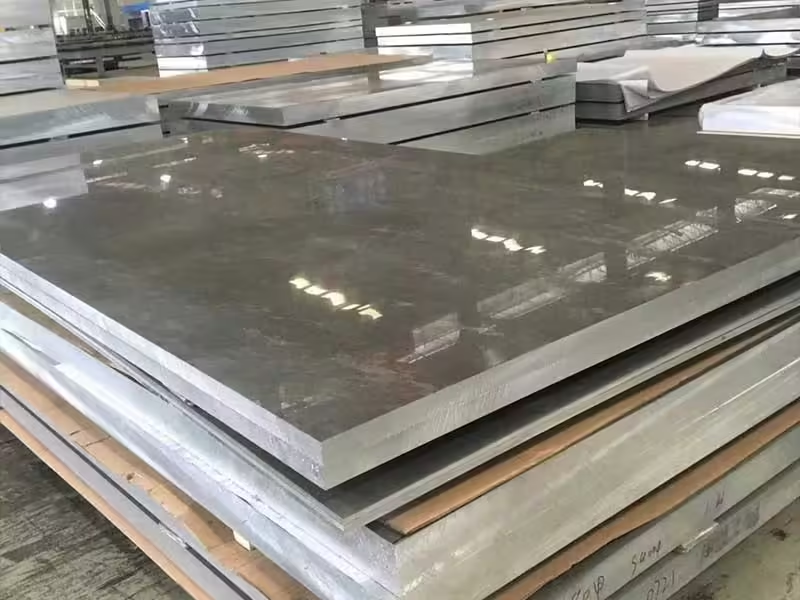
Thickness affects weight, rigidity, strength, machining allowance, and material consumption.
Thicker aluminum plate generally provides greater rigidity, which can be important for machine bases, structural components, fixtures, and heavy-duty equipment.
Thinner plate may be more suitable for panels, covers, enclosures, and fabricated components where low weight and formability are more important.
Buyers should not select thickness based solely on availability. The required thickness should be related to the load, finished dimensions, manufacturing process, and expected service conditions.
Aluminum Plate Thickness for CNC Machining
CNC machining requires sufficient material for removing excess metal and achieving the final dimensions.
If the raw plate is too close to the finished thickness, there may not be enough machining allowance to correct flatness or surface imperfections.
For precision components, the buyer should provide both the raw material dimensions and the finished component requirements whenever possible.
Why Is Aluminum Plate Tolerance Important?
Tolerance determines how much the actual dimension can deviate from the specified value.
For general fabrication, standard commercial tolerances may be sufficient. Precision components, however, can require tighter control.
Thickness Tolerance
Thickness tolerance affects the amount of available machining material and can influence the final weight of a component.
Width and Length Tolerance
Width and length tolerances become particularly important when plates are cut into blanks for automated machining or fabrication.
Flatness Tolerance
Flatness is especially important for large aluminum plates used in CNC machining, tooling, machine bases, and precision fixtures.
A plate can meet its nominal thickness while still having insufficient flatness for a precision application.
For this reason, buyers should specify flatness separately when it is important to the finished product.
What Surface Finishes Are Available for Aluminum Plate?
Surface finish is another important part of aluminum plate specifications.
The appropriate finish depends on whether the material will be machined, painted, anodized, polished, coated, or used directly as a visible surface.
Mill Finish
Mill finish is the standard surface condition produced during rolling and processing.
It is widely used for industrial aluminum plate that will undergo further machining, fabrication, coating, or finishing.
For many CNC machining applications, mill finish provides a practical starting point because the final surface will be created during processing.
Brushed Aluminum Finish
Brushed aluminum has a directional texture that provides a consistent visual appearance.
It is often used for architectural products, equipment panels, decorative components, and other applications where appearance is important.
Polished Aluminum Finish
Polished aluminum provides a smoother and more reflective appearance.
It is commonly selected for decorative products, visible equipment components, and applications where surface appearance is a major consideration.
Anodized Aluminum Plate
Anodizing creates a controlled oxide layer on the aluminum surface and can improve corrosion resistance, surface hardness, and appearance.
However, the final anodized appearance can vary depending on alloy composition and surface preparation.
If the aluminum plate will be anodized after fabrication, buyers should communicate this requirement to the supplier before selecting the alloy.
Protective Film
Protective film can help prevent scratches during transportation, cutting, bending, and installation.
It is particularly useful for aluminum plate that will be used directly as a visible surface.
How Should Aluminum Plate Be Selected for CNC Machining?
CNC machining requires careful consideration of material stability.
6061 aluminum plate is widely used for CNC machining because it offers a good balance between strength, machinability, availability, and cost.
7075 can be considered when a machined component requires substantially higher strength. However, the additional material cost should be justified by the application.
When purchasing aluminum plate for CNC machining, buyers should consider:
- Alloy and temper
- Raw thickness
- Finished thickness
- Flatness
- Machining allowance
- Internal stress
- Surface condition
- Required dimensional tolerance
Large parts are particularly sensitive to internal stress. When significant amounts of material are removed from one side of a plate, deformation can occur.
This is why precision machining projects should communicate the finished drawing and machining process to the aluminum supplier whenever possible.
How Does Surface Treatment Affect Aluminum Performance?
Surface treatment can significantly influence the performance and appearance of an aluminum component.
The best treatment depends on the working environment and final application.
| Surface Treatment | Main Benefit | Typical Applications |
|---|---|---|
| Anodizing | Corrosion resistance and surface hardness | Equipment and architecture |
| Powder Coating | Color and environmental protection | Panels and enclosures |
| Polishing | Smooth and reflective appearance | Decorative components |
| Brushing | Uniform surface texture | Architectural products |
| Protective Film | Scratch protection | Fabrication and transportation |
For outdoor equipment, corrosion protection may be more important than appearance. For architectural applications, color consistency and surface uniformity may be equally important.
Surface treatment should therefore be considered during material selection rather than after the aluminum has already been purchased.
What Quality Checks Should Be Performed Before Shipment?
Quality inspection helps ensure that the aluminum plate delivered to the customer matches the agreed specification.
For industrial orders, inspection can cover chemical composition, mechanical properties, dimensions, flatness, surface quality, and packaging.
Chemical Composition
Chemical analysis can confirm that the supplied material corresponds to the specified alloy.
Mechanical Properties
Depending on the project, buyers may require verification of tensile strength, yield strength, elongation, or hardness.
Dimensional Inspection
Thickness, width, length, and flatness should be checked against the agreed requirements.
Surface Inspection
The plate should be inspected for scratches, dents, cracks, stains, oxidation, rolling marks, and other visible defects.
Quality Documentation
For industrial and international orders, buyers may request material certificates or inspection documentation to support internal quality control and customer acceptance.
How Do Aluminum Plate Specifications Affect Procurement Cost?
The final procurement cost depends on much more than alloy price.
Custom dimensions, tight tolerances, special surface finishes, additional inspection, cutting services, and special packaging can all affect the total cost.
For example, requesting standard plate dimensions may reduce processing requirements. However, custom-cut plate may reduce material waste and machining preparation at the customer’s facility.
The most economical solution should therefore be evaluated based on the entire production process.
Buyers should avoid paying for specifications that do not contribute to product performance, but they should also avoid reducing specifications that are essential for quality.
How Should Aluminum Plate Be Selected for Different Applications?
Application requirements should guide material selection.
CNC Machined Components
Machining projects generally prioritize machinability, dimensional stability, flatness, and sufficient machining allowance.
6061 aluminum plate is commonly selected for general industrial CNC components, while higher-strength grades may be used for specialized applications.
Construction and Architecture
Construction applications often require corrosion resistance, surface quality, coating compatibility, and consistent dimensions.
For visible architectural products, surface finish may be as important as mechanical performance.
Marine Applications
Marine environments expose aluminum to moisture and salt, making corrosion resistance particularly important.
5052 and 5083 aluminum are commonly considered for marine-related applications depending on the design, load requirements, and fabrication process.
Machinery Manufacturing
Machine components often require a balance between strength, machinability, dimensional stability, and cost.
Selecting a material based only on strength may result in unnecessary expenses. The alloy should match the actual mechanical requirements of the component.
How Should Buyers Prepare an Aluminum Plate RFQ?
A detailed RFQ helps suppliers provide a more accurate quotation.
Instead of simply writing:
“Please quote aluminum plate.”
A professional inquiry should identify the required alloy, temper, thickness, width, length, quantity, standard, surface finish, tolerance, application, processing requirements, packaging, and documentation.
If the buyer does not know which alloy to select, providing the application and performance requirements can be enough for a professional supplier to recommend suitable options.
For larger OEM projects, technical drawings are even more useful because they allow the supplier to evaluate material dimensions, cutting requirements, tolerances, and production feasibility before quotation.
Why Choose Huanhai Zhongke for Aluminum Plate Supply?
Huanhai Zhongke supplies aluminum plate along with other aluminum products, including aluminum coil, aluminum rod, and aluminum foil for industrial and international customers.
The company can support customers requiring different aluminum grades, dimensions, surface conditions, and application-specific requirements.
For buyers sourcing aluminum materials for machinery, construction, transportation, energy, HVAC, or other industrial applications, providing a complete technical specification helps establish clearer communication from quotation through delivery.
Customers can also review the company’s aluminum product range before submitting a specific material inquiry.
Conclusion
Choosing the right aluminum plate requires a complete understanding of alloy, temper, thickness, tolerance, flatness, surface finish, standards, inspection, and application requirements.
For CNC machining, dimensional stability and machinability can be critical. For construction and architectural products, surface quality and corrosion resistance may receive greater attention. For marine applications, alloy selection and corrosion resistance become especially important.
A well-defined aluminum plate specification reduces procurement risks, minimizes misunderstandings, and makes it easier for suppliers to provide accurate quotations.
For international buyers, the most effective approach is to provide the intended application, required dimensions, preferred alloy and temper, applicable standard, surface requirements, processing needs, and inspection documentation at the beginning of the purchasing process.
FAQ
What are the most important aluminum plate specifications?
The most important specifications include alloy, temper, thickness, width, length, tolerance, flatness, surface finish, applicable standard, quantity, and packaging.
What aluminum plate is commonly used for CNC machining?
6061 aluminum plate is widely used for CNC machining because it combines good machinability, strength, corrosion resistance, and availability.
What is the difference between aluminum alloy and temper?
The alloy defines the chemical composition, while temper describes the material’s mechanical condition after heat treatment, cold working, aging, or other processing.
Why is flatness important when buying aluminum plate?
Flatness affects machining accuracy and assembly performance. It is particularly important for large CNC components, tooling plates, machine bases, and precision fixtures.
Can aluminum plate be anodized?
Yes. Many aluminum alloys can be anodized, although the final appearance and performance depend on the alloy, surface preparation, and anodizing process.
 English
  Korean
  Arabic
  Vietnamese