

In modern pharmaceutical manufacturing, packaging plays a decisive role in drug stability and regulatory compliance. For high-value and moisture-sensitive medications, standard blister solutions may not provide sufficient protection. This is why cold form aluminum foil for pharmaceutical packaging is widely adopted in premium drug packaging applications.
Cold form foil offers near-total barrier performance against moisture, oxygen, and light. For pharmaceutical companies that require maximum product integrity during storage and international transportation, cold form aluminum foil represents a reliable and proven solution.
목차
What Is Cold Form 알루미늄 호일 for Pharmaceutical Packaging
Cold form aluminum foil is a multilayer laminated material typically composed of:
- OPA (Oriented Polyamide)
- 알루미늄 호일
- PVC
The OPA/AL/PVC structure allows the material to be mechanically formed into blister cavities without heat. Unlike thermoforming films, cold form aluminum foil for pharmaceutical packaging relies on cold mechanical forming, which enhances barrier integrity.
The aluminum layer functions as the primary protective barrier. The OPA layer provides mechanical strength and flexibility, while the PVC layer ensures sealing compatibility with lidding foil.
This structural design makes cold form foil especially suitable for sensitive pharmaceutical products.
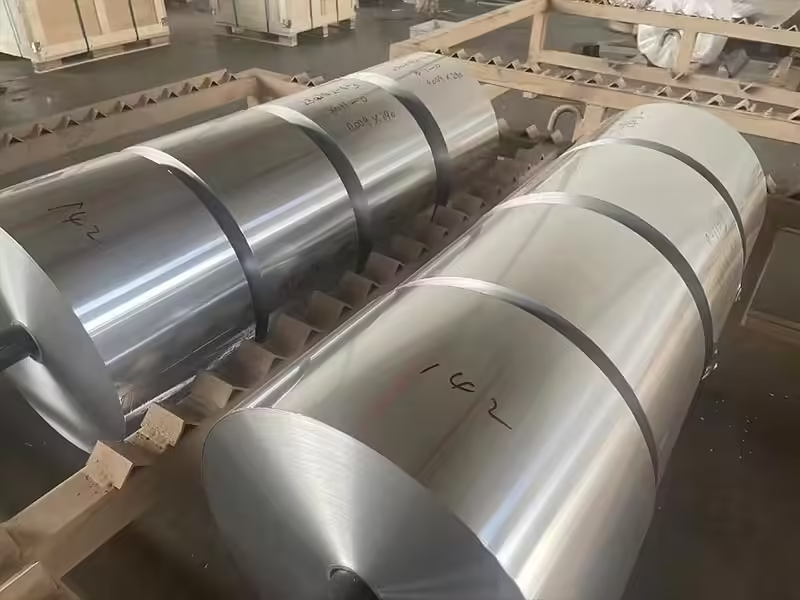
Structure and Technical Specifications
| 매개변수 | 표준 범위 |
|---|---|
| Structure | OPA / AL / PVC |
| Aluminum Thickness | 20–50 microns |
| Total Thickness | 140–160 microns |
| 폭 범위 | 100–800 mm |
| Forming Depth | Deep cavity capable |
| Barrier Performance | Near 100% |
| 애플리케이션 | Tablets & Capsules |
The aluminum layer thickness directly influences barrier properties and forming performance. High-quality cold form aluminum foil for pharmaceutical packaging ensures uniform lamination, consistent thickness, and stable forming results.
Why High-Barrier Performance Matters
Pharmaceutical products can be extremely sensitive to environmental exposure. Moisture absorption may degrade active ingredients, while oxygen exposure can reduce drug efficacy.
Cold form foil provides:
- Complete light shielding
- Extremely low moisture transmission rate
- Excellent oxygen barrier
- Extended shelf life
- Tamper-evident structure
Because aluminum is impermeable, cold form aluminum foil effectively isolates the product from external conditions. This makes it ideal for export pharmaceuticals exposed to temperature and humidity fluctuations during global shipping.
Comparison: Cold Form vs Standard Blister Packaging
| 특징 | Cold Form Aluminum Foil | Standard Blister Film |
|---|---|---|
| Barrier Level | Maximum | Moderate to High |
| Light Protection | 100% | Partial |
| Moisture Resistance | Near 100% | 제한된 |
| Transparency | Opaque | Transparent base |
| 비용 | 더 높은 | 낮추다 |
| Suitable for Sensitive Drugs | 예 | 제한된 |
While thermoformed blister packs are widely used, cold form aluminum foil for pharmaceutical packaging remains the preferred option when maximum protection is required.
Formability and Mechanical Strength
One of the most important technical aspects of cold form foil is its ability to undergo deep drawing without cracking.
High-quality material ensures:
- Excellent ductility
- Uniform cavity depth
- No aluminum fracture
- Stable forming edges
- Reduced production defects
Reliable forming performance increases blister line efficiency and reduces material waste.
Sealing Performance and Compatibility
The PVC layer of cold form aluminum foil is engineered to provide secure sealing with aluminum lidding foil. Stable heat-seal strength is essential to prevent leakage and maintain barrier integrity.
Well-manufactured cold form aluminum foil for pharmaceutical packaging ensures consistent peel strength and sealing reliability during high-speed production.
Quality Control Standards
Pharmaceutical packaging materials must comply with strict quality requirements. Manufacturing cold form foil typically involves:
- Aluminum purity verification
- Lamination adhesion testing
- Pin-hole inspection
- Moisture transmission testing
- Mechanical strength testing
- Visual surface inspection
Production must follow GMP guidelines and maintain cleanroom standards to prevent contamination.
규정 준수
Cold form aluminum foil used in pharmaceutical applications must meet:
- FDA requirements
- EU pharmaceutical packaging regulations
- GMP manufacturing standards
- ISO quality management systems
Batch traceability and certificate documentation are essential for pharmaceutical buyers.
Applications of Cold Form Aluminum Foil
Cold form aluminum foil for pharmaceutical packaging is commonly used in:
- High-value prescription medications
- Moisture-sensitive tablets
- Effervescent products
- Nutraceutical supplements
- Export-oriented pharmaceutical brands
Its superior barrier capability makes it ideal for products requiring long shelf life and strict stability protection.
Supply Stability and Production Continuity
For pharmaceutical manufacturers, packaging supply stability is critical. Delays in material procurement can disrupt production schedules.
Reliable suppliers of cold form aluminum foil provide:
- Consistent specification control
- Custom width slitting
- Stable batch quality
- Fast international shipment
- Inventory support for urgent orders
Ensuring material availability helps pharmaceutical companies maintain uninterrupted production and meet delivery commitments.
Market Growth and Industry Trends
Global pharmaceutical demand continues to expand due to:
- Aging populations
- Increasing healthcare awareness
- Growth in generic drugs
- Rising export volumes
As regulatory requirements become more stringent, the demand for cold form aluminum foil for pharmaceutical packaging continues to increase. High-barrier packaging solutions are no longer optional for many sensitive medications.

지속가능성 고려사항
Although cold form foil is a multilayer composite material, aluminum remains recyclable. Ongoing research focuses on improving sustainable pharmaceutical packaging solutions while maintaining strict barrier performance.
Balancing protection and environmental responsibility is becoming a key industry direction.
결론
Cold form aluminum foil remains one of the most reliable high-barrier solutions in pharmaceutical packaging. Its multilayer structure, superior formability, and complete light and moisture protection make it ideal for sensitive drug applications.
By selecting high-quality cold form aluminum foil for pharmaceutical packaging, manufacturers ensure product stability, regulatory compliance, and long-term storage safety. Stable specifications, consistent performance, and controlled production standards are essential for pharmaceutical packaging success.
자주 묻는 질문
What makes cold form aluminum foil different from standard blister packaging?
Cold form aluminum foil provides near 100% barrier protection, while standard blister films offer partial protection.
What is the typical aluminum thickness in cold form foil?
The aluminum layer usually ranges from 20 to 50 microns depending on application needs.
Is cold form aluminum foil suitable for export pharmaceuticals?
Yes, it protects drugs from humidity and temperature changes during international transportation.
Can cold form aluminum foil be customized in width?
Yes, widths can be tailored to match different blister production lines.
Why is cold form aluminum foil used for high-value drugs?
Because it provides maximum barrier protection, extending shelf life and maintaining drug stability.
 Korean
  English
  Arabic
  Vietnamese