

Seamless steel pipe applications cover a wide range of industrial systems where strength, pressure resistance, dimensional reliability, and material performance are important. Unlike welded pipe, seamless pipe is produced without a longitudinal weld seam, making it a practical option for many demanding fluid, gas, mechanical, and structural applications.
The right pipe, however, depends on the working environment. Pressure, temperature, transported medium, corrosion conditions, mechanical loads, and applicable standards all influence material selection.
For engineers, contractors, procurement teams, and industrial buyers, understanding where seamless steel pipe is used can make it easier to determine whether it is appropriate for a specific project.
목차
What Is Seamless Steel Pipe Used For?
Seamless steel pipe is used when a project requires a continuous steel tube without a longitudinal welded joint.
일반적인 응용 프로그램은 다음과 같습니다:
- Oil and gas systems
- Power generation
- Petrochemical processing
- Boiler and heat exchanger systems
- Hydraulic equipment
- 산업기계
- 자동차 부품
- Structural engineering
- Pressure piping
- General fluid transportation
The required pipe specification varies considerably between these applications.
For example, a structural application may prioritize mechanical strength and dimensional stability, while a high-temperature piping system may place greater emphasis on temperature resistance and material performance.
This is why understanding the application should come before selecting the final pipe specification.
왜인가 Seamless Pipe Used in Industrial Applications?
The manufacturing process of seamless pipe provides several characteristics that can be valuable in industrial service.
Because there is no longitudinal weld seam, the pipe has a continuous material structure around its circumference.
Depending on the selected grade and manufacturing specification, seamless pipe can provide:
- 높은 기계적인 힘
- Good resistance to internal pressure
- Reliable performance under demanding conditions
- Consistent material properties
- Suitability for high-temperature applications
- Options for different grades and dimensions
These characteristics make 이음매 없는 강관 a common choice for applications where pressure, mechanical loading, or operating conditions place significant demands on the piping system.
However, seamless construction alone does not guarantee suitability. The material grade, wall thickness, manufacturing standard, heat treatment, and inspection requirements must also match the application.
Seamless Steel Pipe Applications in Oil and Gas
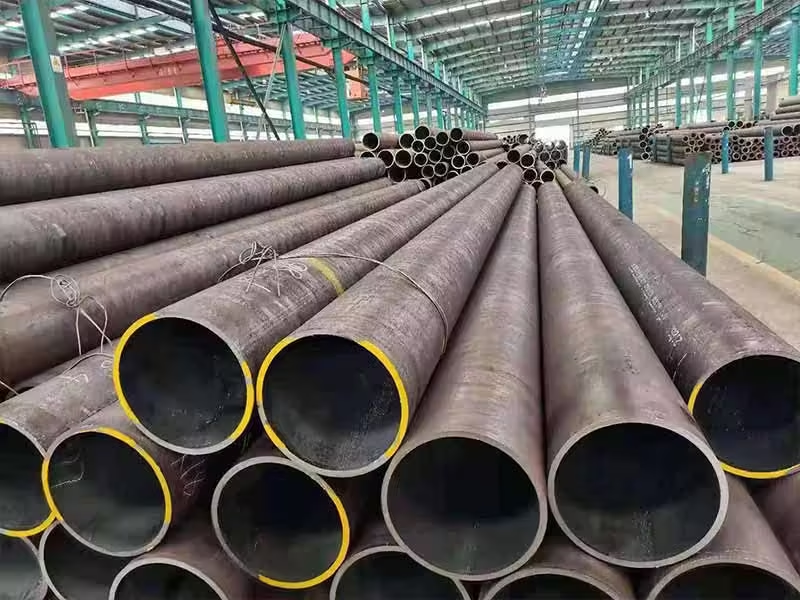
Oil and gas is one of the most important areas for seamless steel pipe applications.
Pipes may be used in systems that transport crude oil, natural gas, refined products, or other process fluids.
Depending on the specific application, the pipe may need to withstand:
- 높은 내부 압력
- 온도 변화
- 기계적 스트레스
- Vibration
- Corrosive environments
- Long-term continuous operation
Material selection is therefore critical.
For pipeline and process applications, buyers should identify the required material grade and applicable standard before ordering. Requirements may also include impact testing, chemical composition control, dimensional tolerances, and material traceability.
For projects involving oil and gas service, seamless steel pipe sizes should also be evaluated alongside the required operating conditions to determine the appropriate dimensional specification.
Seamless Steel Pipe in Power Generation
Power plants use piping systems throughout boilers, steam systems, heat exchangers, feedwater systems, and other equipment.
These applications can expose pipe to elevated temperatures and pressures for extended periods.
As a result, seamless steel pipe applications in power generation often require careful evaluation of:
- Operating temperature
- Design pressure
- Material strength
- Creep resistance
- 열처리
- 치수 안정성
- Testing requirements
The appropriate steel grade depends on the exact service conditions.
A material suitable for a relatively low-temperature water system may not be appropriate for high-temperature steam service.
For this reason, power-generation projects normally specify both the material grade and manufacturing standard in detail.
Seamless Pipe for Boiler Systems
Boiler systems require materials capable of operating under pressure and elevated temperatures.
Seamless steel pipes can be used in boiler-related components and associated piping where the applicable specification permits their use.
Important selection factors include:
- 온도 범위
- Working pressure
- 재질 등급
- 벽 두께
- 열처리
- 기계적 성질
- Inspection requirements
Long-term exposure to elevated temperature can affect material properties, so the selected grade must be appropriate for the intended service conditions.
Seamless Steel Pipe Applications in Petrochemical Plants
Petrochemical facilities contain numerous process systems that transport hydrocarbons, chemicals, steam, and other fluids.
Piping can be exposed to combinations of pressure, heat, chemical exposure, and mechanical stress.
Seamless pipe may therefore be considered for applications where material integrity and pressure performance are important.
Material selection should account for:
- Chemical composition of the transported medium
- Operating temperature
- Pressure
- 부식 환경
- Required service life
- Applicable industry standard
For corrosive service, stainless or alloy steel grades may be more appropriate than conventional carbon steel, depending on the actual chemical environment.
The selected grade should always be verified against the process conditions.
Seamless Steel Pipe for Hydraulic Systems
Hydraulic equipment relies on controlled fluid pressure to transmit power.
Hydraulic piping therefore requires suitable dimensional accuracy, strength, and connection compatibility.
Seamless steel pipe can be used in certain hydraulic applications where its material and dimensional characteristics meet the system requirements.
Important considerations include:
- Hydraulic working pressure
- Pipe dimensions
- 벽 두께
- 재질 등급
- 표면 상태
- Connection method
- Required cleanliness
Hydraulic applications can be particularly sensitive to contamination and internal surface conditions. The pipe preparation and handling requirements should therefore be defined before delivery.
Seamless Pipe in Heat Exchanger Systems
Heat exchangers transfer heat between fluids through controlled thermal contact.
Depending on the equipment design, seamless tubes or pipes may be used for fluid circulation and heat-transfer service.
Selection considerations can include:
- Operating temperature
- Pressure
- Thermal cycling
- Fluid compatibility
- 내식성
- 차원 정확도
- Required surface condition
The material must remain stable under the expected thermal and mechanical conditions.
In applications involving aggressive fluids, corrosion resistance can be just as important as mechanical strength.
Seamless Steel Pipe Applications in Automotive Manufacturing
Automotive manufacturing uses steel tubing in various components and production systems.
Seamless tubing may be considered for applications where strength, dimensional consistency, and resistance to mechanical loads are important.
Potential uses include:
- Mechanical components
- Hydraulic systems
- 구조 구성 요소
- Precision tubing
- Specialized automotive assemblies
The appropriate grade and dimensional specification depend on the component design.
For precision applications, tighter dimensional control may be required than for general industrial piping.
Seamless Steel Pipe in Industrial Machinery
Industrial machinery often incorporates steel tubes into hydraulic, pneumatic, mechanical, and structural systems.
A seamless pipe can be useful when the component needs to withstand pressure or mechanical loads without relying on a longitudinal welded joint.
Examples include:
- Hydraulic equipment
- Cylinders
- Machine structures
- Pressure systems
- Mechanical assemblies
- 산업용 장비
In these applications, dimensional accuracy and compatibility with other components can be particularly important.
Seamless Pipe for Structural Applications
Not all seamless steel pipe applications involve fluid transportation.
Steel tubes can also be used as structural members.
Structural applications may include:
- Building structures
- Industrial frames
- Equipment supports
- Machinery structures
- Infrastructure components
For these applications, buyers may prioritize load-bearing capacity, steel grade, outside dimensions, wall thickness, and corrosion protection.
The engineering design should determine the required dimensions and material properties rather than selecting pipe solely based on availability.
Seamless Steel Pipe for High-Pressure Service
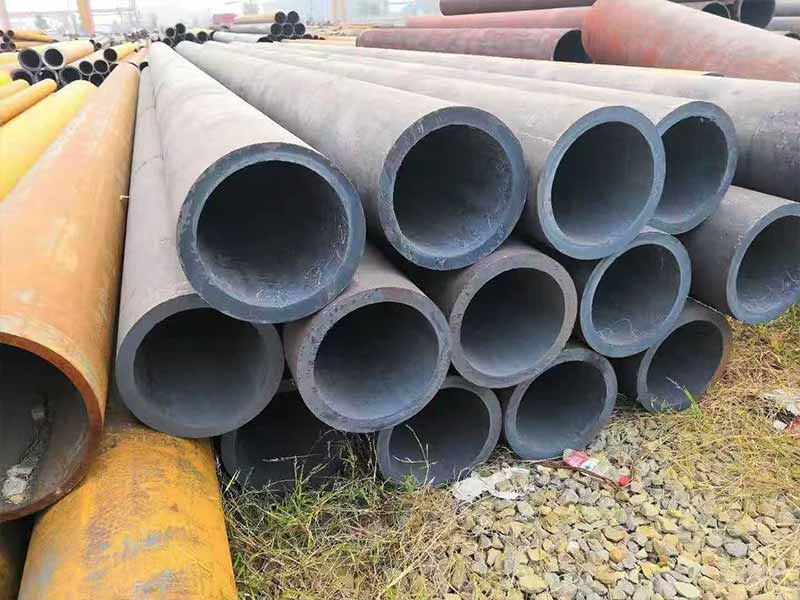
High-pressure applications are among the situations where material and dimensional selection become particularly important.
Potential applications include:
- Hydraulic systems
- Oil and gas equipment
- High-pressure process piping
- Power-generation equipment
- Industrial pressure systems
The pipe must be evaluated according to the complete operating environment.
Pressure capability depends on multiple factors, including:
- Material strength
- Outside diameter
- 벽 두께
- Operating temperature
- 제조 표준
- Design code
A high-strength material does not automatically make every pipe suitable for high-pressure service.
The engineering design should determine the required combination of grade and dimensions.
Seamless Steel Pipe Applications in Chemical Processing
Chemical processing systems may handle fluids that are corrosive, toxic, reactive, or sensitive to contamination.
Material compatibility is therefore essential.
Before selecting a pipe, buyers should identify:
- 화학 성분
- Concentration
- Temperature
- Pressure
- Flow conditions
- Exposure duration
- Potential contaminants
Depending on the environment, carbon steel, alloy steel, or stainless steel may be considered.
The correct choice should be based on actual corrosion and compatibility data rather than assumptions about a particular material category.
Seamless Pipe for Gas Transportation
Gas transportation systems require careful control of pressure, material properties, and dimensional specifications.
Seamless steel pipe can be used in certain gas-handling systems when the material and manufacturing specification meet the project requirements.
Important factors include:
- Gas composition
- Operating pressure
- Temperature
- 부식 환경
- Required toughness
- Pipe dimensions
- 적용 규격
For critical systems, material traceability and inspection documentation can also be important.
How Temperature Affects Seamless Pipe Applications
Temperature is a major factor in determining whether a particular seamless pipe is suitable.
At low temperatures, impact toughness can become a concern.
At elevated temperatures, strength retention, oxidation, creep, and long-term material stability may become more important.
The pipe grade should therefore be selected based on the complete expected temperature range.
This is particularly important in power generation, petrochemical processing, boilers, and heat-transfer equipment.
How Corrosion Affects Application Selection
Corrosion can reduce pipe wall thickness and eventually compromise system integrity.
The risk depends on the transported medium and surrounding environment.
Potential causes include:
- 수분
- Chemicals
- Chlorides
- Acids
- Alkaline solutions
- Marine environments
- High-temperature oxidation
Material grade selection, corrosion allowance, surface treatment, and operating conditions should all be considered.
In some environments, stainless or alloy materials may offer advantages over conventional carbon steel.
Choosing Between Seamless and Welded Pipe
The choice between seamless and welded pipe depends on the specific application.
Seamless pipe can be attractive for demanding pressure and mechanical applications where its manufacturing characteristics provide a useful performance advantage.
Welded pipe can be advantageous for certain large-diameter or cost-sensitive applications.
The decision should consider:
- Pressure requirements
- 지름
- 벽 두께
- 재질 등급
- 애플리케이션
- 제조 표준
- 비용
- 유효성
- Fabrication requirements
Neither construction method is universally better. The appropriate option depends on the engineering requirements.
How Seamless Steel Pipe Grades Affect Applications
Different seamless steel pipe grades are designed for different performance requirements.
Carbon steel may be suitable for many general industrial applications.
Alloy steel may provide advantages for elevated-temperature or demanding mechanical service.
Stainless steel can be considered where corrosion resistance is a major requirement.
The selected grade should be matched to the application rather than chosen simply because it is commonly used.
For a more detailed discussion of material selection, buyers can refer to our guide on seamless steel pipe grades.
How Dimensions Affect Seamless Pipe Applications
Pipe dimensions influence both system performance and installation.
Outside diameter determines how the pipe interfaces with fittings and surrounding equipment.
Wall thickness influences mechanical strength and internal flow area.
Length affects transportation, fabrication, and installation.
For this reason, the correct application requires both an appropriate material grade and a suitable dimensional specification.
For more information, see our guide to seamless steel pipe sizes and dimensions.
What Should Buyers Tell a Seamless Pipe Supplier?
When requesting seamless steel pipe for an industrial application, buyers should provide as much technical information as possible.
A useful inquiry should include:
- Intended application
- Pipe material
- Required grade
- Outside diameter or nominal size
- 벽 두께
- 길이
- 적용 규격
- Operating pressure
- Operating temperature
- 수량
- Testing requirements
- Certification requirements
- 포장 요구 사항
Providing this information helps the supplier understand the actual requirement instead of quoting a generic pipe specification.
How to Select Seamless Steel Pipe for a New Project
A practical selection process can follow the sequence below:
1. Define the application
Determine whether the pipe will transport fluid, handle gas, support a structure, or form part of industrial equipment.
2. Identify operating conditions
Confirm pressure, temperature, flow conditions, mechanical loads, and surrounding environment.
3. Select the material
Evaluate carbon steel, alloy steel, stainless steel, or another appropriate grade according to the service environment.
4. Determine dimensions
Select outside diameter, wall thickness, and length according to engineering requirements.
5. Confirm standards
Make sure the selected material and dimensions comply with the required ASTM, ASME, API, EN, DIN, JIS, or project specification.
6. Define inspection requirements
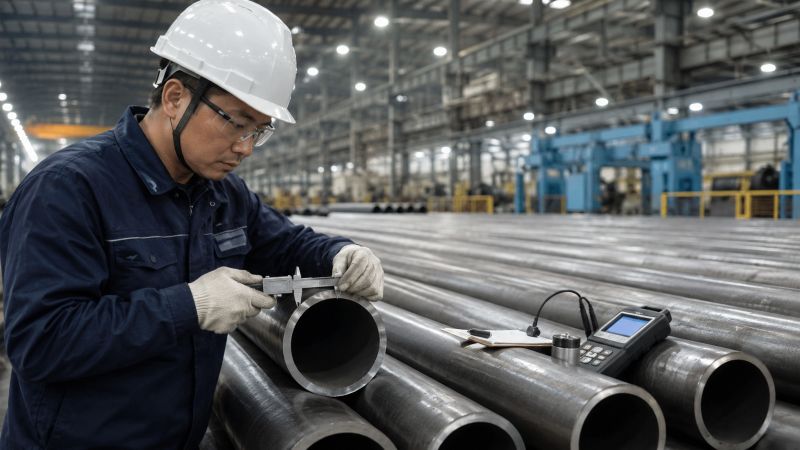
Determine whether material certificates, mechanical testing, dimensional inspection, or other documentation is required.
This process helps connect the final pipe specification with the actual operating requirements.
자주 묻는 질문
What are the main seamless steel pipe applications?
Major applications include oil and gas, power generation, petrochemical processing, hydraulic systems, heat exchangers, industrial machinery, structural engineering, and pressure piping.
Is seamless steel pipe suitable for high-pressure applications?
It can be suitable for certain high-pressure applications when the material grade, wall thickness, dimensions, manufacturing standard, and design requirements are appropriate.
Can seamless steel pipe be used at high temperatures?
Certain seamless steel pipe grades are designed for elevated-temperature service. The correct grade should be selected according to the actual operating temperature and applicable specification.
Is seamless pipe better than welded pipe?
Not universally. Seamless pipe can provide advantages for certain demanding applications, while welded pipe can be more suitable for other projects. Selection should be based on engineering requirements.
How do I choose the right seamless steel pipe for my application?
Start with the service conditions, including pressure, temperature, medium, corrosion environment, and mechanical loads. Then select the material grade, dimensions, standard, and testing requirements accordingly.
결론
Seamless steel pipe applications extend across many industries, from oil and gas and power generation to hydraulic equipment, chemical processing, machinery, and structural engineering.
The best pipe for a project depends on more than whether it is seamless. Material grade, dimensions, pressure, temperature, corrosion conditions, manufacturing standards, and inspection requirements all need to be considered together.
By defining the application and operating conditions first, buyers can develop a more accurate pipe specification and select a solution that provides the required performance throughout its service life.
 Korean
  English
  Arabic
  Vietnamese