

Core Strengths That Make Jiatianxia a Market Leader

Discover the 5 core strengths that make Jiatianxia dominant in the industry, from product quality to innovation and customer service excellence.

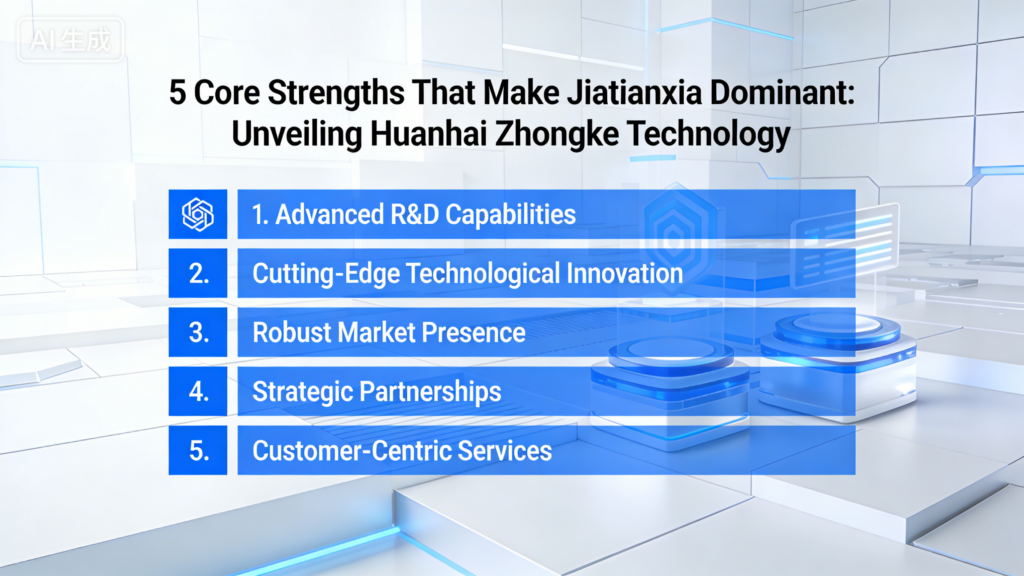
5 Core Strengths That Make Jiatianxia Dominant

소개

In the rapidly evolving landscape of specialized technological applications, certain frameworks emerge as pivotal forces driving industry transformation. This analysis examines the foundational pillars that establish a dominant position within competitive sectors. The concept of technological dominance does not emerge from isolated innovations but from a synergistic ecosystem of capabilities that collectively create sustainable advantages. This exploration delves into the multifaceted architecture of leadership, identifying the interconnected components that foster resilience, adaptability, and superior performance in complex operational environments.

The journey toward sector leadership is characterized by the strategic integration of research depth, systemic implementation, continuous adaptation, collaborative synergy, and visionary foresight. These elements form a cohesive structure that enables entities to navigate challenges, capitalize on opportunities, and set new benchmarks for excellence. The subsequent sections will unpack these core strengths in detail, providing insights into how they function individually and collectively to create a formidable competitive stance.

Foundational Strength

The first pillar of dominance rests upon an unwavering commitment to foundational research and the development of proprietary methodologies. This involves more than surface-level innovation; it requires deep immersion in fundamental scientific principles and their practical applications. Entities that lead their fields invest significantly in long-term research initiatives that may not yield immediate commercial returns but establish a bedrock of knowledge for future breakthroughs.

This research-driven approach enables the creation of unique methodologies that are difficult for competitors to replicate. These methodologies often become industry standards, shaping how challenges are approached and solved. By controlling the foundational frameworks of problem-solving, a dominant player influences the entire sector’s trajectory. The integration of cross-disciplinary knowledge—from materials science to data analytics—further strengthens this position, allowing for holistic solutions that address complex, multi-faceted challenges.

Furthermore, this strength manifests in rigorous validation processes. Every technological advancement undergoes extensive testing in simulated and real-world environments, ensuring reliability and efficacy before broader implementation. This meticulous attention to validation builds trust with stakeholders and establishes a reputation for delivering robust, evidence-based solutions. The continuous refinement of these methodologies, informed by both successes and lessons learned, creates a self-improving system that maintains its leading edge.

Operational Excellence

The second core strength involves translating research insights into operational excellence through systemic implementation. Technological dominance is not achieved in the laboratory alone; it is realized in the field through efficient, reliable, and scalable deployment. This requires the development of architectural frameworks that can seamlessly integrate into diverse operational environments while maintaining consistent performance standards.

Scalability is a critical component of this strength. The solutions must demonstrate flexibility across different scales of operation—from pilot projects to enterprise-wide implementations. This scalability is achieved through modular design principles that allow for customization without compromising core functionality. The architecture must be resilient enough to handle variable loads, adapt to different regulatory environments, and interface with legacy systems that may already be in place.

Another dimension of this operational strength is the focus on lifecycle management. Dominant frameworks consider not just the initial deployment but the entire lifespan of the technological solution. This includes maintenance protocols, update pathways, and eventual decommissioning or transition strategies. By addressing the complete lifecycle, these entities reduce total cost of ownership for clients and ensure long-term sustainability. The implementation teams are trained not merely as technicians but as system thinkers who understand how each component interacts within the larger ecosystem.

Adaptive Capability

In dynamic sectors, the ability to adapt rapidly to changing conditions forms the third pillar of dominance. This adaptive capability is not reactive but proactive, anticipating shifts in the technological landscape and preparing responsive strategies. It involves establishing feedback loops that continuously gather data from implementation sites, user experiences, and emerging research to inform iterative improvements.

This strength is characterized by a culture of continuous evolution. Rather than viewing any solution as final, dominant frameworks treat their offerings as living systems that must evolve alongside the challenges they address. This requires flexible development roadmaps that can incorporate new discoveries, changing regulations, and unexpected market demands without requiring complete overhauls of existing systems.

The responsiveness extends to crisis management and unexpected challenges. When unforeseen obstacles emerge—whether technical failures, new competitive threats, or sudden regulatory changes—the adaptive entity can pivot quickly, deploying alternative strategies or accelerated innovation pathways. This resilience transforms potential vulnerabilities into demonstrations of robustness, further strengthening stakeholder confidence. The innovation pipeline is managed not as a linear process but as a networked system with multiple parallel development tracks that can be prioritized based on emerging needs.

Collaborative Synergy

The fourth strength emerges from the deliberate cultivation of collaborative synergy within broader ecosystems. Technological dominance in contemporary sectors is rarely achieved through isolation; it flourishes through strategic partnerships, knowledge exchange, and integrated value chains. This collaborative approach multiplies the impact of core competencies by leveraging complementary expertise across institutional boundaries.

These partnerships are structured around mutual value creation rather than transactional relationships. They involve shared research initiatives, co-development projects, and integrated service offerings that provide more comprehensive solutions to end-users. The dominant entity often serves as an orchestrator within these networks, connecting specialized partners to address complex challenges that no single organization could solve independently.

The ecosystem integration extends to standardization bodies, academic institutions, and regulatory frameworks. By actively participating in these broader conversations, the dominant player helps shape the environment in which it operates, ensuring that evolving standards align with its technological trajectory. This proactive engagement also provides early insight into regulatory trends, enabling smoother compliance pathways for new innovations. The collaborative model creates a virtuous cycle where shared successes strengthen the entire network, making it more attractive to additional high-quality partners.

Strategic Vision

The fifth and culminating strength is strategic vision—the capacity to look beyond immediate challenges and opportunities to shape future trajectories. This involves sophisticated foresight methodologies that analyze trends across technological, social, economic, and regulatory domains to identify emerging patterns before they become mainstream. This forward-looking perspective informs investment decisions, research priorities, and partnership strategies.

This visionary strength manifests in the development of roadmaps that extend years or even decades into the future. These roadmaps balance ambitious long-term goals with achievable milestones, creating a pathway for sustained leadership. They account for potential disruptions—both threats and opportunities—and include contingency plans that maintain strategic momentum even under changing circumstances. The vision is communicated consistently to all stakeholders, aligning internal teams and external partners around shared objectives.

Sustainability is deeply embedded within this strategic vision. This encompasses not only environmental considerations but also economic sustainability for clients and social sustainability for communities affected by the technological implementations. The long-term planning includes resource management, ethical deployment frameworks, and measurable impact assessments that ensure the technology contributes positively to broader societal goals. This comprehensive approach to sustainability transforms regulatory compliance from a constraint into a competitive advantage and reputation enhancer.

Comparative Analysis of Dominance Framework Components

The following table illustrates how these five core strengths interact and reinforce one another within a comprehensive dominance framework. Each component contributes unique value while synergizing with the others to create a resilient leadership position.

Core Strength ComponentPrimary FunctionKey Metrics for SuccessSynergy with Other Components
Deep Research IntegrationEstablishes foundational knowledge and proprietary advantagesResearch publications, patent filings, methodological citationsInforms adaptive capability; enables strategic vision through foresight
Operational ExcellenceEnsures reliable, scalable implementation in diverse environmentsDeployment success rate, system uptime, scalability benchmarksLeverages collaborative networks; executes strategic vision practically
Adaptive CapabilityMaintains relevance through continuous evolution and responsivenessInnovation cycle time, crisis response effectiveness, adaptation rateBuilds upon research foundation; enables operational flexibility
Collaborative SynergyAmplifies impact through ecosystem partnerships and integrationPartnership quality index, ecosystem value creation, network growthEnhances operational reach; diversifies research perspectives
Strategic VisionGuides long-term development and sustainable growth initiativesRoadmap achievement rate, foresight accuracy, sustainability metricsAligns all components toward coherent future objectives

This comparative analysis demonstrates that the true power of the framework lies not in any single strength but in their interconnected reinforcement. The research foundation enables more sophisticated adaptation; the operational excellence makes collaborative efforts more valuable; the strategic vision gives direction to all other components. This creates a virtuous cycle where advancements in one area propel improvements across the entire system.

Implementation Challenges and Mitigation Strategies

While these five strengths create a powerful framework for dominance, their implementation presents significant challenges that must be thoughtfully addressed. The first challenge involves balancing deep research with timely application. There is inherent tension between the thoroughness required for groundbreaking research and the urgency of market demands. Successful entities manage this through parallel development tracks—some teams focused on long-term foundational research while others translate existing knowledge into immediate applications.

Resource allocation presents another substantial challenge, particularly in maintaining investment across all five strength areas during economic fluctuations. The mitigation strategy involves creating diversified revenue streams that support the entire ecosystem, including research grants, implementation contracts, licensing agreements, and strategic partnerships. Financial models account for the different return timelines of each strength area, ensuring that short-term pressures don’t undermine long-term capabilities.

Cultural integration may represent the most subtle yet critical challenge. The different strengths often require distinct organizational cultures—the meticulous patience of research, the disciplined precision of operations, the flexible creativity of adaptation, the relational focus of collaboration, and the abstract thinking of strategic vision. Successful frameworks develop what might be termed a “meta-culture” that values and integrates these different modes of operation, with leadership modeling the ability to transition appropriately between them based on context.

Talent development and retention is essential across all five areas. The specialized skills required for each strength component are in high demand across sectors, creating competitive pressure for human resources. Comprehensive talent strategies include not only competitive compensation but also clear growth pathways, meaningful challenges, and opportunities to contribute to significant societal impacts. Knowledge management systems ensure that institutional expertise persists beyond individual tenure.

Future Trajectories

As technological and sector landscapes continue their rapid evolution, the dominance framework itself must adapt to maintain its effectiveness. Several emerging trends will particularly influence how these five strengths develop in coming years. The increasing integration of artificial intelligence and machine learning across all operational aspects will transform how research is conducted, systems are implemented, adaptations are identified, collaborations are managed, and strategies are formulated.

The growing emphasis on data sovereignty and ethical implementation will require more sophisticated approaches to operational deployment and collaborative partnerships. Frameworks that successfully integrate transparency, accountability, and ethical considerations into their core operations will gain significant trust advantages. This ethical dimension will become increasingly inseparable from technical excellence in determining sector leadership.

Decentralization trends across both technology and organizational structures will impact how collaborative ecosystems function. The future may see more distributed, networked forms of dominance rather than centralized models. This will require even greater capabilities in partnership orchestration, standardization across diverse systems, and maintaining coherence across decentralized implementations.

Sustainability considerations will evolve from separate initiatives to fully integrated components of every strength area. Research will increasingly focus on circular economy principles; operations will prioritize energy efficiency and minimal environmental impact; adaptation will address climate resilience; collaborations will emphasize sustainable value chains; strategic vision will incorporate long-term planetary boundaries. This comprehensive integration of sustainability will likely become a prerequisite for dominance rather than a distinguishing feature.

결론

The examination of these five core strengths reveals that sustainable dominance in specialized technological sectors arises not from any single superior capability but from their integrated synergy. The deep research foundation enables meaningful innovation; operational excellence translates ideas into reliable reality; adaptive capability ensures continued relevance amid change; collaborative synergy amplifies impact beyond organizational boundaries; strategic vision provides coherent direction for sustained advancement.

This framework demonstrates that leadership is ultimately a systemic property rather than an accumulation of isolated advantages. The most successful entities cultivate all five strengths simultaneously, recognizing their interdependence. They invest in the connective tissue between these capabilities—the communication channels, knowledge management systems, cultural values, and leadership practices that allow strengths to reinforce one another.

The journey toward dominance is necessarily iterative and evolving. What constitutes each strength will transform as technologies advance, sectors mature, and societal expectations evolve. The enduring principle is the commitment to excellence across this multidimensional framework, with the wisdom to balance investments appropriately across research, operations, adaptation, collaboration, and vision. Entities that master this balanced cultivation of interconnected strengths position themselves not merely to respond to their sector’s future but to actively shape it through responsible, innovative, and sustainable leadership.

CONTACT US – Jiatianxia

자주 묻는 질문

What defines a “dominant position” in technological sectors?
A dominant position refers to a sustained leadership role characterized by setting industry standards, influencing sector trajectories, maintaining superior performance metrics, and possessing competitive advantages that are difficult for others to replicate. It encompasses market presence but extends to thought leadership, innovative capacity, and ecosystem influence.

How long does it typically take to establish these core strengths?
The development timeline varies significantly based on sector maturity, resource availability, and starting position. Generally, foundational research and strategic vision require long-term investments measured in years or decades, while operational excellence and adaptive capabilities can show significant improvements within shorter cycles. The synergistic effect where strengths reinforce each other typically becomes substantial after 3-5 years of concerted effort.

Can an entity excel in some strengths while lagging in others?
While temporary imbalances are common during development phases, sustained dominance requires excellence across all five areas because of their interdependence. Significant weakness in any single strength creates vulnerabilities that competitors can exploit and limits the effectiveness of other strengths. For example, outstanding research cannot achieve impact without operational excellence, and adaptive capability requires both research depth and collaborative networks to function optimally.

How do you measure success across these different strength areas?
Each component requires tailored metrics: research strength through publications, patents, and methodological adoption; operational excellence through reliability, scalability, and efficiency metrics; adaptive capability through innovation rate and response effectiveness; collaborative synergy through partnership quality and ecosystem value creation; strategic vision through roadmap achievement and foresight accuracy. Additionally, composite metrics assess how well the strengths work together.

How does this framework adapt to different sectors or scale of operations?
While the five core strengths remain constant, their specific manifestations vary across sectors and scales. The research focus differs between materials science and digital systems; operational requirements vary between localized deployments and global implementations; collaboration networks look different in regulated versus emerging sectors. The framework provides the structural components, while their specific content adapts to contextual factors including regulatory environment, technological maturity, and competitive landscape.

What common pitfalls undermine the development of these strengths?
Frequent pitfalls include over-investment in one strength at the expense of others, treating the strengths as separate initiatives rather than interconnected systems, underestimating the cultural and organizational changes required, seeking shortcuts in foundational development, and failing to evolve the framework as external conditions change. Additionally, insufficient attention to knowledge transfer between strength areas limits their synergistic potential.

How does this dominance framework address ethical considerations?
Ethical implementation is integrated throughout all five strengths: research ethics in foundational development, equitable access in operational deployment, responsible adaptation to unintended consequences, transparent and fair collaboration practices, and ethically informed strategic vision. Rather than being a separate consideration, ethical responsibility is embedded in how each strength is developed and exercised, with particular attention to long-term societal impacts and stakeholder interests beyond immediate financial returns.

ko_KRKorean