

Stainless steel coil for heat exchanger manufacturing plays a critical role in modern industrial thermal systems. Heat exchangers are essential components used to transfer heat between fluids without direct mixing. They are widely installed in power plants, petrochemical facilities, HVAC systems, marine engineering, refrigeration systems, and food processing industries.
Because these systems operate under fluctuating temperatures, continuous pressure, and corrosive fluid exposure, material selection directly impacts operational safety, energy efficiency, and long-term maintenance costs. Stainless steel coil for heat exchanger manufacturing provides the corrosion resistance, mechanical strength, and fabrication flexibility required to meet demanding industrial standards.
As industries increasingly focus on energy efficiency and emission reduction, high-performance heat exchangers have become indispensable. Stainless steel coil ensures durability and consistent thermal performance even in aggressive service environments.
Mục lục
Working Conditions of Industrial Heat Exchangers
Heat exchangers are subjected to complex operating conditions such as:
High temperature variation and thermal cycling
Pressurized fluid circulation
Chloride-rich cooling water
Chemical process liquids
Condensation environments
High humidity and marine exposure
These factors accelerate corrosion and material fatigue. Stainless steel coil forms a stable chromium oxide layer that protects against oxidation and pitting corrosion. This passive film automatically regenerates when damaged, ensuring long-term surface protection.
Types of Heat Exchangers Using Stainless Steel Coil
Stainless steel coil is widely used in manufacturing different exchanger structures:
Plate heat exchangers
Shell and tube heat exchangers
Air-cooled heat exchangers
Condensers and evaporators
Double-pipe heat exchangers
Industrial cooling coils
Each design requires precise material thickness, forming performance, and welding reliability. Coil supply allows efficient stamping, forming, and automated production processes.
Common Thép không gỉ Grades and Selection Logic
304 Stainless Steel Coil
304 stainless steel coil is commonly selected for:
Freshwater cooling systems
HVAC heat transfer units
Food-grade thermal equipment
Low-chloride industrial fluids
Advantages include:
Excellent weldability
Stable mechanical properties
Khả năng chống ăn mòn tốt
Cost-effective material option
For general-purpose thermal applications, 304 provides balanced performance and affordability.
316 Stainless Steel Coil
316 stainless steel coil includes molybdenum, which enhances resistance to chloride-induced pitting and crevice corrosion. It is recommended for:
Marine cooling systems
Seawater condensers
Chemical heat exchangers
Desalination facilities
Aggressive industrial process fluids
In chloride environments, 316 significantly extends operational lifespan compared to 304.
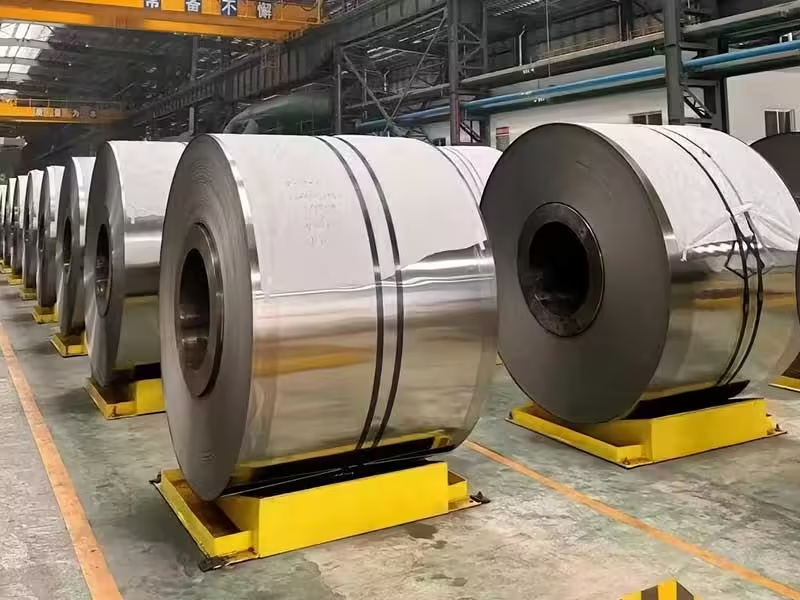
Technical Specifications Overview
| Tham số | Phạm vi điển hình | Sự miêu tả |
|---|---|---|
| Cấp | 304 / 316 | Corrosion-resistant heat exchanger material |
| Độ dày | 0.3–3.0 mm | Plate and tube forming |
| Chiều rộng | 600–1500 mm | Suitable for stamping lines |
| Hoàn thiện bề mặt | 2B / BA | Smooth surface for heat transfer |
| Độ bền kéo | ≥520 MPa | Structural stability |
| Sự kéo dài | ≥40% | Forming capability |
| Tiêu chuẩn | ASTM A240 / EN 10088 | International compliance |
Selecting the correct thickness depends on pressure rating, operating temperature, and exchanger configuration.
Heat Transfer and Surface Performance
Surface condition directly affects heat transfer efficiency. Rough surfaces encourage fouling and scaling, reducing thermal efficiency over time.
2B finish offers a smooth industrial surface suitable for most applications.
BA finish provides a brighter and smoother surface, reducing fouling and improving cleanability.
Lower fouling rates improve long-term energy efficiency and reduce cleaning frequency.
Mechanical Strength and Pressure Resistance
Heat exchangers often operate under medium to high pressure. Stainless steel coil provides:
High tensile strength
Strong yield strength
Good resistance to deformation
Stable performance under vibration
These properties ensure safe operation even under fluctuating load conditions.
Thermal Fatigue Resistance
Repeated heating and cooling cycles can cause micro-cracking in low-quality materials. Stainless steel exhibits strong resistance to thermal fatigue due to its balanced microstructure and alloy composition.
This makes stainless steel coil for heat exchanger manufacturing particularly suitable for continuous industrial operation.
Fabrication Advantages for OEM Manufacturers
Stainless steel coil improves production efficiency because it supports:
High-speed stamping for plate exchangers
Precision roll forming for tube production
Automated TIG and laser welding
CNC cutting for custom components
Consistent thickness control
Coil format reduces material waste and enables scalable mass production.
Comparison with Alternative Materials
Stainless Steel vs Carbon Steel
Carbon steel is vulnerable to rust and scaling in wet environments. Protective coatings are required and may degrade over time. Stainless steel provides inherent corrosion resistance without additional coating.
Stainless Steel vs Copper
Copper offers higher thermal conductivity but suffers from lower mechanical strength and corrosion resistance in chemical and saline environments. In aggressive industrial systems, stainless steel provides superior durability and lower lifecycle cost.
For long-term reliability in harsh environments, stainless steel coil remains a preferred industrial solution.
Ứng dụng trong ngành
Stainless steel coil for heat exchanger manufacturing is widely used in:
Thermal power plants
Oil and gas refineries
Chemical processing units
Industrial refrigeration systems
Marine engine cooling systems
HVAC central air systems
Food and beverage heat processing
Its performance stability makes it suitable for both heavy-duty industrial units and compact modular exchangers.
Quality Control and Certification
Professional stainless steel coil suppliers ensure strict quality control, including:
Chemical composition testing
Kiểm tra tính chất cơ học
Surface inspection
Thickness tolerance measurement
PMI verification
Mill Test Certificates
Compliance with ASTM A240 and EN 10088 guarantees global engineering acceptance.
Supply Capacity for Industrial Projects
Large heat exchanger manufacturers and EPC contractors require consistent raw material supply. Reliable suppliers provide:
Large inventory of 304 and 316 grades
Stable monthly production capacity
Custom slitting and cutting services
Protective packaging for export
Flexible delivery schedules
Stable supply ensures uninterrupted equipment manufacturing and project execution.
Market Outlook
Global industrial development and increasing demand for energy-efficient systems continue to drive growth in heat exchanger production. Environmental regulations and energy conservation initiatives further accelerate the adoption of high-performance materials.
As industries prioritize durability, efficiency, and reduced maintenance, stainless steel coil for heat exchanger manufacturing remains a critical material in global thermal engineering markets.
Phần kết luận
Stainless steel coil for heat exchanger manufacturing provides excellent corrosion resistance, structural strength, thermal stability, and fabrication flexibility. It ensures reliable performance across energy, chemical, marine, and HVAC sectors.
For equipment manufacturers and engineering contractors, selecting certified stainless steel coil improves operational safety, extends service life, and enhances long-term cost efficiency.
Câu hỏi thường gặp
Q1: Why is stainless steel preferred in heat exchangers?
Because it offers corrosion resistance, strength, and durability under thermal cycling.
Q2: Is 304 suitable for HVAC systems?
Yes, 304 is widely used in freshwater and HVAC heat exchange systems.
Q3: When should 316 be selected?
316 is recommended for chloride-rich, marine, or chemical environments.
Q4: What surface finish improves heat transfer efficiency?
Smooth finishes such as 2B or BA reduce fouling and scaling.
Q5: Can stainless steel coil support mass production?
Yes, coil format enables efficient stamping and automated fabrication processes.
 Vietnamese
  English
  Korean
  Arabic