
Table of Contents
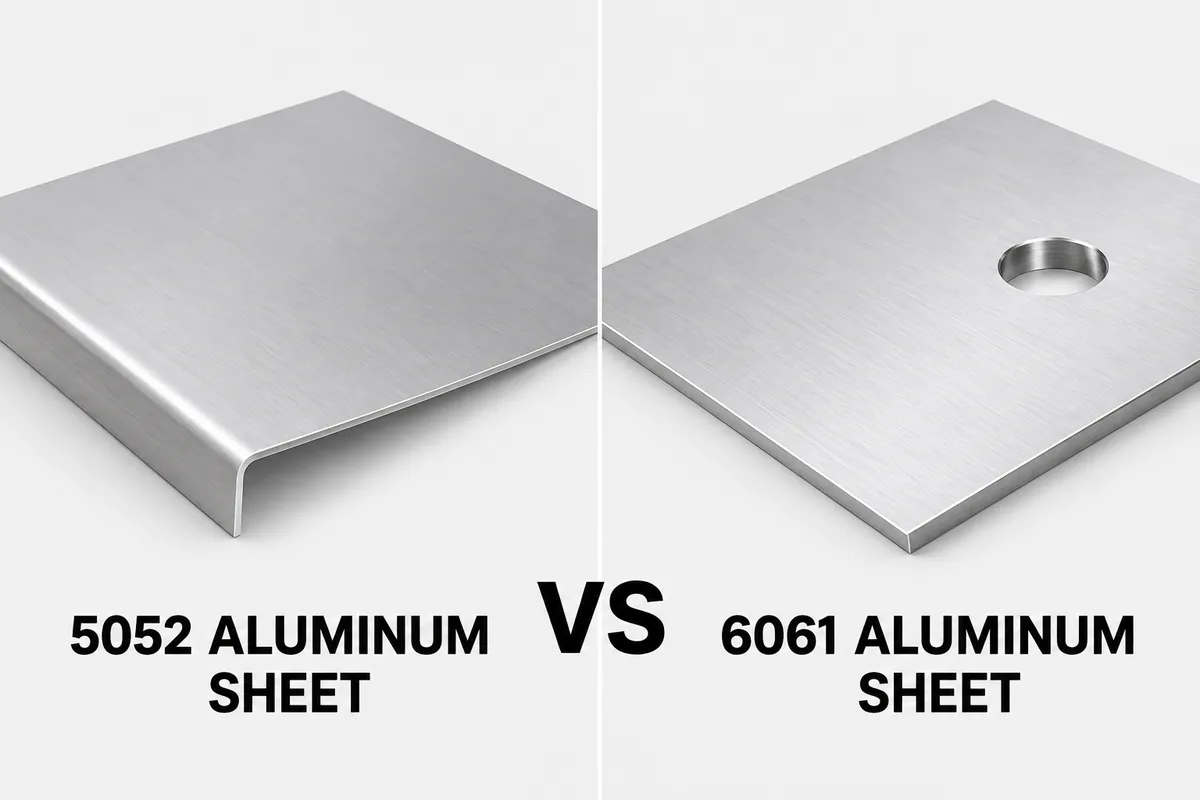
Choosing between 5052 vs 6061 aluminum sheet is a part-design decision, not a contest with one universal winner. The correct material depends on required strength, bend severity, joining method, corrosion exposure, surface finish, dimensional tolerance, certification, and the condition in which the finished component must perform.
A reliable 5052 vs 6061 aluminum sheet comparison must also identify temper and product form. Alloy 5052 is a non-heat-treatable aluminum-magnesium alloy, while 6061 is a heat-treatable aluminum-magnesium-silicon alloy. Those families respond differently to cold work, thermal treatment, forming, welding, and machining, so an alloy number without a temper is not a complete purchase specification.
Start With the Part
Begin the 5052 vs 6061 aluminum sheet review with the drawing and service conditions. Define whether the part is a deeply formed enclosure, a bent bracket, a welded tank, a machined panel, a structural member, or a visible cover. Record loads, stiffness needs, bend radii, joint design, temperature, chemical contact, marine atmosphere, finish, life-cycle inspection, and applicable design code.
Separate material properties from component performance. A stronger temper does not automatically produce a better component if it cracks during forming, loses relevant properties in a weld zone, corrodes at an assembly interface, or cannot meet flatness after processing. The 5052 vs 6061 aluminum sheet decision should therefore be approved by engineering, fabrication, quality, and purchasing against the same acceptance criteria.
Compare the Alloy Families
The principal alloying addition in 5052 is magnesium, and the alloy is strengthened by strain hardening rather than precipitation heat treatment. Common sheet tempers include annealed and strain-hardened conditions. This combination makes 5052 a frequent candidate for formed sheet-metal parts and corrosion-exposed fabrications, subject to the exact design and environment.
Alloy 6061 uses magnesium and silicon and can be supplied in heat-treated tempers. It is widely considered where higher strength, machinability, or structural use is important. In a 5052 vs 6061 aluminum sheet specification, verify that the requested alloy, temper, chemical limits, and product form follow recognized designation rules such as the Aluminum Association Teal Sheets.
Compare Strength and Forming
For many formed parts, a 5052 vs 6061 aluminum sheet comparison shows that 5052 in a suitable temper can offer more forgiving bend and draw behavior than 6061 in a high-strength heat-treated temper. That is a general selection tendency, not a guaranteed bend radius. Thickness, grain direction, inside radius, tooling, edge quality, surface condition, forming speed, and lot variation still control whether the part can be made without cracking or unacceptable distortion.
For load-carrying or machined parts, 6061 in a specified heat-treated condition may offer the required strength and dimensional response. The 5052 vs 6061 aluminum sheet choice should use minimum design values permitted by the governing code or engineering method, not a single typical value from an undated table. Prototype the most severe bend, hole pattern, machined pocket, and load path using representative production material.
Evaluate Corrosion Exposure
A 5052 vs 6061 aluminum sheet assessment can identify useful corrosion-resistant options, but the actual exposure determines suitability. Identify moisture, salt, industrial atmosphere, cleaning chemicals, trapped water, dissimilar-metal contact, sealants, coatings, drainage, and maintenance. Sheet used near salt water has different risks from an indoor machine panel, even when the nominal alloy and thickness are identical.
The 5052 vs 6061 aluminum sheet review must include the finished assembly rather than bare coupons alone. Welding, grinding, heat, fasteners, scratches, crevices, and coatings can change local behavior. Do not convert a broad statement that 5052 is often selected for marine or wet environments into a blanket service guarantee. Use project corrosion expertise and exposure testing when failure consequences justify it.
Review Welding and Joining
In a 5052 vs 6061 aluminum sheet project, both alloy families can be joined, but weldability does not mean the welded assembly retains every property of the parent sheet. Joint design, filler selection, process, heat input, restraint, cleaning, porosity control, distortion, inspection, and post-weld service all matter. Heat-affected regions in heat-treated 6061 require particular attention in structural calculations and acceptance.
Can 5052 and 6061 be welded together? A qualified procedure can join them in appropriate applications, but the answer depends on section thickness, joint loading, applicable code, filler compatibility, corrosion environment, finishing, and required properties. A 5052 vs 6061 aluminum sheet purchasing decision should not name a universal filler or procedure without welding-engineering review and representative qualification.
Select Temper and Thickness
Temper can change a 5052 vs 6061 aluminum sheet fabrication outcome as much as the alloy family. Specify the complete designation, such as an annealed, strain-hardened, or heat-treated condition appropriate to the drawing. Then state nominal thickness, tolerance, width and length, flatness, surface finish, grain direction if controlled, protected face, and any film requirements. Do not treat one temper as interchangeable with another.
ASTM B209/B209M is a recognized specification for covered aluminum and aluminum-alloy sheet and plate products. A complete 5052 vs 6061 aluminum sheet order must still identify the required alloy, temper, dimensions, tolerances, certification, and supplementary project criteria. Consult the 5052 aluminum sheet temper guide and 6061 aluminum temper and property guide for related selection details.
| Decision factor | 5052 selection tendency | 6061 selection tendency |
|---|---|---|
| Severe sheet forming | Often evaluated first in a suitable soft or strain-hardened temper | Requires close temper, radius, and process qualification |
| Higher structural strength | Confirm whether the specified temper meets the design | Often evaluated in a specified heat-treated temper |
| Machining | Usable when the part and finish permit | Often considered where machining is a major operation |
| Welded assembly | Common candidate; verify joint and service requirements | Account for heat-affected-zone properties and distortion |
| Corrosive exposure | Often considered for wet or marine-related fabrication | Evaluate exact exposure, joints, coating, and maintenance |
Inspect and Certify
At receipt, apply the same 5052 vs 6061 aluminum sheet controls to the purchase order, packing list, labels, and material certificates. Check alloy and temper identification, heat or lot traceability, dimensions, flatness, surface condition, edge damage, protective film, packaging, and quantity. Use calibrated equipment and a documented sampling plan appropriate to the risk. Isolate material when records or markings conflict.
For a controlled 5052 vs 6061 aluminum sheet substitution, require written engineering approval before production. Review strength basis, forming trials, weld procedure, corrosion plan, finish compatibility, fasteners, mass, machining, inspection, and regulatory obligations. Positive material identification may be appropriate for critical work, but the method, detection limits, sampling, and acceptance authority must be defined.
- Define the finished part, service, load, and governing standard.
- Specify the complete alloy and temper designation.
- Qualify bends, draws, machining, and joining on representative material.
- Evaluate corrosion on the finished assembly, including dissimilar contacts.
- Set dimensional, flatness, surface, and cosmetic acceptance criteria.
- Require certificates, lot traceability, inspection, and change approval.
- Document the 5052 vs 6061 aluminum sheet decision in the drawing and RFQ.
Write the RFQ
An effective RFQ states the material standard and edition, alloy, temper, thickness and tolerance, sheet size, flatness, finish, cosmetic face, grain direction, film, quantity, certificate type, traceability, inspection reports, marking, packaging, and destination. Attach the drawing revision and identify forming, welding, machining, coating, anodizing, or bonding that follows delivery.
When requesting a 5052 vs 6061 aluminum sheet recommendation, give the supplier the decision criteria rather than asking which alloy is best. Include bend geometry, loads, environment, joint method, finish, critical dimensions, prototype quantity, annual demand range, and deviation process. A technically complete inquiry supports a defensible material recommendation and exposes assumptions before production.
FAQ
Is 6061 aluminum better than 5052?
No alloy is universally better. In a 5052 vs 6061 aluminum sheet review, 6061 may be preferred for higher-strength heat-treated or machined parts, while 5052 may be preferred for demanding sheet forming and some corrosion-exposed fabrications. Temper, geometry, joining, and service decide the result.
Can 6061 and 5052 be welded together?
They can be joined for suitable applications using an engineered and qualified welding procedure. The 5052 vs 6061 aluminum sheet joint still requires review of filler compatibility, heat-affected properties, distortion, corrosion, finishing, inspection, and the governing code.
What is 5052 aluminum good for?
5052 is commonly considered for formed sheet-metal parts, enclosures, tanks, covers, and corrosion-exposed fabrications. Suitability depends on temper, thickness, forming severity, joints, environment, finish, and design requirements rather than the alloy name alone.
Which bends more easily, 5052 or 6061 aluminum sheet?
5052 in a suitable temper is often more forgiving for demanding bends than 6061 in a high-strength heat-treated temper. A 5052 vs 6061 aluminum sheet bend decision must still qualify thickness, grain direction, radius, tooling, edges, and surface condition.
Can 5052 sheet replace 6061 sheet on an existing drawing?
Only after engineering review and written approval. A 5052 vs 6061 aluminum sheet substitution can affect strength, stiffness, forming, machining, welding, corrosion, finish, inspection, and compliance, so purchasing should not make the change independently.
Request an Alloy Review
Send Huanhai Zhongke the drawing, application, alloy and temper options, thickness, bend geometry, loads, joining method, corrosion exposure, finish, inspection, certification, and packaging requirements for a 5052 vs 6061 aluminum sheet material review.
 English
  Korean
  Arabic
  Vietnamese